African Agriculture Barometer
The FARM Foundation, in partnership with Afdi and the PAFO, has created a tool to serve African farmers' organizations and, more generally, public and private decision-makers for analyze food sovereignty and to guide agricultural policies.
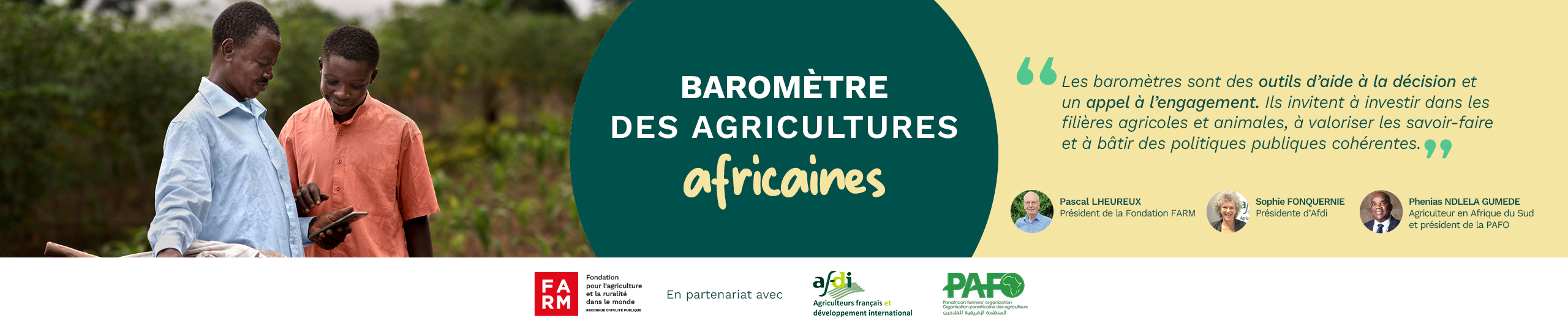
Sector by sector, The Barometer offers a reliable source of strategic analysis to understand agricultural interdependencies and guide more equitable partnerships with Africa.
Our objectives
Why the Barometer? To address a critical need
- The health, geopolitical and climate crises of recent years have highlighted the vulnerability of food systems, while reviving debates around food sovereignty at a time when there is a strong need for investment.
- Faced with this situation, the representative organizations African producers have expressed the need for access to reliable data, updated and comparable data to guide their strategy and strengthen the continent's food sovereignty.
- To address this, the FARM Foundation and its partners have created a innovative analysis tool sectoral to decipher the dependencies and dynamics of local production, sector by sector.
- The Barometers address the Sustainable Development Goals: SDGs 1, 2, 8, 9, 12, 13
Partners
Afdi (French Farmers and International Development) is an international solidarity association created by French agricultural professional organizations that supports family farms in developing countries, enabling producers to earn a decent living and address food security challenges. Present in 21 countries in Africa, Asia, and the Eastern Caribbean, Afdi conducts strategic partnerships with nearly 70 farmers' organizations.
The Pan-African Farmers' Organization (PAFO) represents more than 80 million African farmers. Founded in 2010 under the auspices of the African Union, it federates five regional networks of farmers' organizations, bringing together nearly 73 national organizations in more than 48 countries. It aims to strengthen the role of farmers in African agricultural policies and to promote a strong and inclusive African agriculture.
Who is the Barometer aimed at?
The Barometer is designed as a decision-making tool for three target audiences, with a concrete benefit for each: 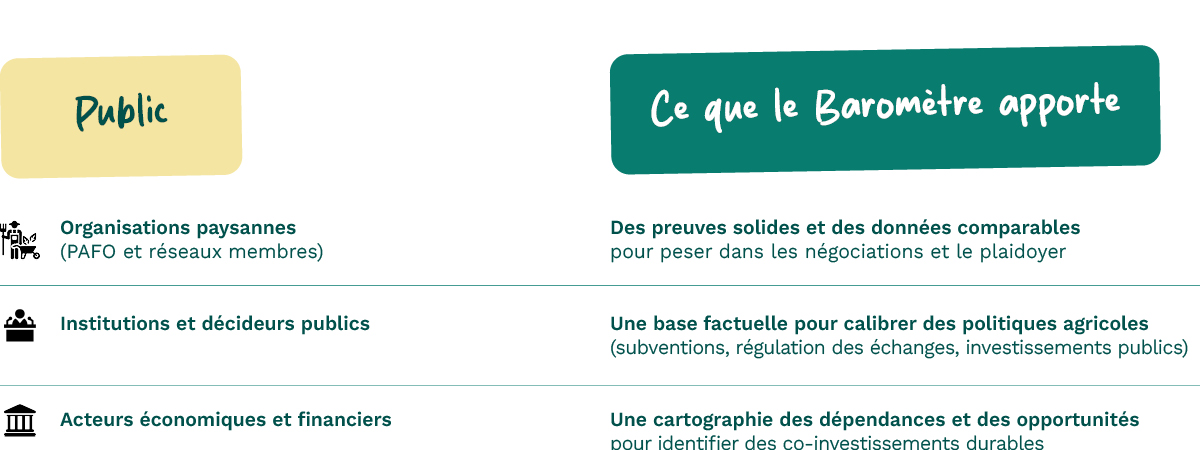
Methodology: the power of analysis
The Barometer is based on a rigorous and visual approach, reproduced for each sector studied.
- Robust data : cross-referencing international databases (FAOSTAT, UN Comtrade, World Bank), sectoral sources and scientific bibliography, supplemented by an analysis of investment flows and economic actors.
- Six themes of analysis common to all editions : production, trade, consumption, investment, public policy, future challenges.
- Educational visual tools : bilingual maps, sector infographics, dashboards, forward-looking analyses.
Each edition of the Barometer is delivered through a full range of deliverables: a bilingual dashboard available in PDF and soon to be linked to an interactive online platform, educational content (videos, articles) tracing the dynamics of flows and dependencies of the sector studied, bilingual visual tools to map dependencies and public policies by country, as well as a series of presentations at major agricultural and advocacy events in France and internationally.
Download our Barometers
Dairy sector barometer (2025)

Download / Download
The 2025 edition The Barometer offers a well-documented analysis of the challenges facing the African dairy sector, to aid decision-making and encourage commitment. Five key observations structure this analysis:
▾ A still untapped potential
Only 51% of the world's milk is produced in Africa, despite the majority of the world's dairy farmers being there. Production is increasing (+171% in ten years), but self-sufficiency has been declining since 2013.
▾ Infrastructure that is blocking the supply chain
Roads, electricity: the lack of infrastructure hinders the collection and processing of milk on the ground.
▾ Organize to have influence
Producer organizations are key: without the capacity for collective representation, there can be no effective supply chain strategy.
▾ Climate, youth, land: challenges to be addressed together
Climate change, intra-African trade, inclusion of youth and women, land conflicts — there is only one possible answer: the systemic and participatory approach.
Investing and dialogue are not possible without each other.
The future of the sector will depend on investments co-constructed with local stakeholders, supported by interprofessional dialogue aligned with the SDGs and the African Union's Agenda 2063.
Fertilizer barometer (2026)
Observations and issues
The 2026 edition of the Barometer analyzes the silent crisis of African soil fertility, to aid decision-making and call for action. Five key findings structure this analysis:
▾ Depleted soils, growing production
651,000 tons of African arable land is degraded, but nitrogen and phosphorus production has almost doubled in ten years. Paradoxically, more than 801,000 tons of mineral fertilizers manufactured on the continent are exported.
▾ Potassium, the blind spot of fertility
No potash deposits have been exploited to date, even though this nutrient leaves the soil four times faster than it enters it. This is the number one structural crisis, invisible in aggregate NPK balances.
▾ An addiction to shocks from elsewhere
Iran, Russia, Ukraine, Canada: Africa's main suppliers are changing in step with wars and sanctions. Transportation can add up to 451 TP3T to the price paid by a landlocked farmer.
▾ Almost all states intervene to support access to fertilizers.
At least 46 of the 54 African countries now regulate the fertilizer market in one way or another (price, distribution, credit or taxation). Some countries are beginning to support organic fertilizers.
▾ Combine the levers, don't oppose them
Mineral, organic, biological: none is sufficient on its own. Since the Nairobi Declaration (2024), fertility is considered on a case-by-case basis, according to soils and crops — with farmers' organizations as actors, not just beneficiaries.
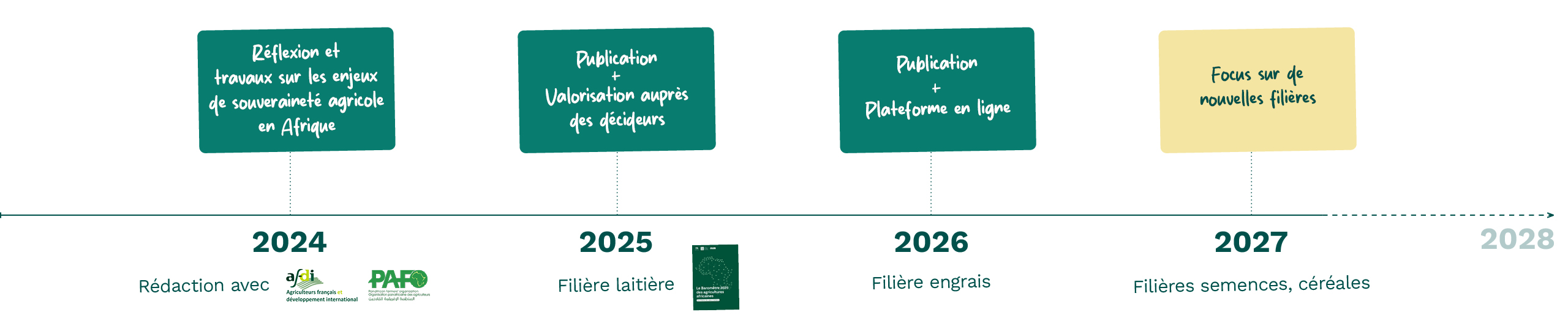
Coming soon: an interactive online platform produced with the support of FranceAgriMer
Support the Barometer: shedding light on the sovereignty of tomorrow
To ensure the sustainability of this tool and to extend it to new strategic sectors, the FARM Foundation and its partners are seeking partners to finance future editions.
- Next thematic priorities : seeds, cereals (rice, wheat), plant protection products
If you would like to get involved in this project and contribute to its development, please do not hesitate to contact us: thibaut.soyez@fondation-farm.org