Guiana Shield: preparing the future of agriculture in an Amazonian territory
With the support of its partners, the FARM Foundation is launching a collective initiative in an Amazonian region. Through the Plateau des Guianas project, the initial aim is to foster dialogue among local stakeholders and then to develop solutions for the resilience and sustainability of local agriculture.
What territory does the Plateau des Guianas project, led by the Foundation, cover?
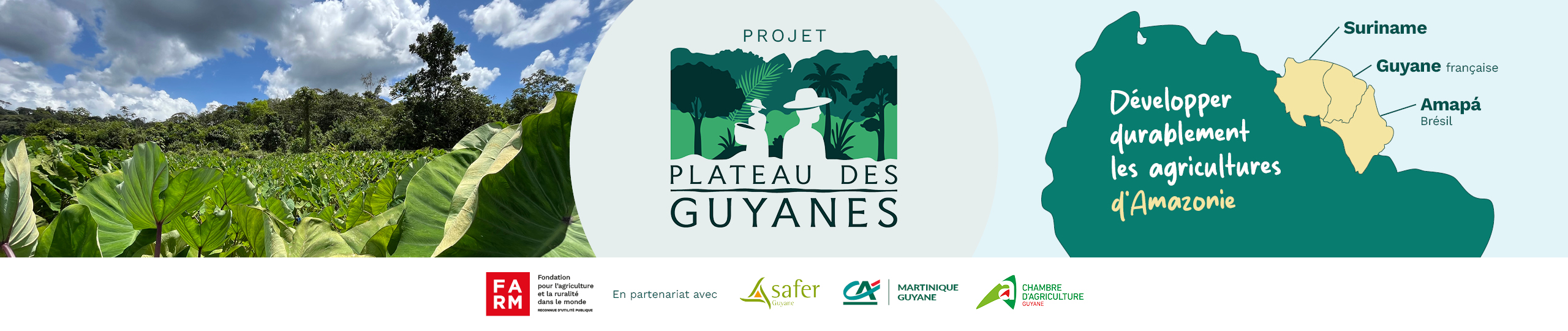
The Guiana Shield is a vast geological formation in the north of the South American continent that extends across the territory of six different countries., including Colombia, Venezuela, Guyana, Suriname, Brazil and overseas France.
For their project, the FARM Foundation and its partners are focusing on the northeastern part of the Plateau, an area which notably covers Suriname, French Guiana and the Brazilian federated state of Amapá.
What is the objective of the "Plateau des Guianas" project?
Through this project, the Foundation and its partners wish to to identify, experiment with and consolidate initiatives for sustainable and equitable agricultural development, adapted to the needs of the populations and to local contexts, in their diversity.
Therefore, the aim will be to reflect on and explore possible courses of action for contribute to reducing dependence on food imports and building food sovereignty in the territory, while working towards the preservation of ecosystems, as well as the restoration and improvement of agricultural soil fertility through environmentally sustainable practices.
White paper: Guyanese agriculture facing the challenge of food sovereignty
Published in October 2026 by the FARM Foundation, the white paper «"Guyanese agriculture faces the challenge of food sovereignty"» is part of the Plateau des Guianas project.
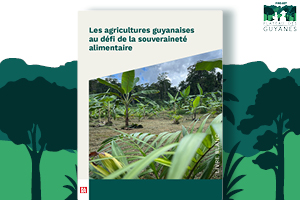
Download the white paper
Launched in Kourou in December 2025, the project aims to to build food sovereignty adapted to the realities of the territories, by reconciling agricultural development and the preservation of ecosystems.
Based on FARM's assessment and discussions with local stakeholders, this white paper offers a common ground for understanding, dialogue, and prioritization. It highlights the main obstacles and interdependencies needed to move from assessment to action and foster new collaborations, projects, and investments.
With the support of the members of the Guiana Shield project steering committee : Crédit Agricole Martinique Guyane, Safer Guyane and the Chamber of Agriculture Guyane.
What is the particularity of this territory from an agricultural point of view?
The uniqueness of this territory, and its agriculture, can be explained by the way in which it has been socially and culturally formed.. The first inhabitants, the Amerindian communities, developed and perfected over the centuries agricultural practices and techniques adapted and consistent with their Amazonian environment, involving the domestication of plants that represent a great diversity and biological richness.
From this Native American cultural and agricultural foundation, While the influence of these cultures persists today, local agriculture has gradually become more diverse thanks to successive waves of migration, which have brought new practices and cultivated species. Communities descended from populations originating in Africa, as well as migrations from other regions of Latin America, have significantly contributed to this agricultural mosaic.
In the case of French Guiana, The arrival of the Hmong, originally from Laos, has added to the existing diversity.
In addition to traditional forms of agriculture, there are also attempts to introduce more conventional farming systems imported from the Global North. These initiatives, sometimes successful, sometimes less so, all contribute to the richness and complexity of the Guyanese agricultural landscape.
What needs does the Plateau des Guianas project intend to address?
The Plateau des Guianas project responds to a dual imperative: reducing alarming food dependency and strengthening local agriculture which is currently too weak to feed rapidly growing populations.
- Reduce food dependency and secure local supply
Strengthening local production and collection to reduce dependence on imports and limit the vulnerability of territories to supply disruptions. In French Guiana, nearly 63% of the food consumed is imported.
- Strengthening the economic weight of agriculture
Increasing agriculture's contribution to GDP: currently, the added value of agriculture represents approximately 10% of GDP in Suriname, 4% in French Guiana, and less than 2% in the state of Amapá. The project aims to structure value chains to increase these ratios and develop agricultural activities that are productive, profitable, and job-creating.
- Reconciling population growth and agricultural production
To address the strong demographic growth of the Guiana Shield, where the population has increased by 12.5 million over the last decade, driven by French Guiana with 23 million inhabitants. The objective is to support this growth with proportionate agricultural development in order to avoid exacerbating inequalities and social tensions.
- Integrating conservation and economic development
Promoting agroecological and agroforestry practices that restore soil fertility and preserve forests, while generating sustainable income and protecting still well-preserved ecosystems.
By combining these levers — regional public policies, targeted funding, strengthening of producer organizations and supply chains, and cross-border action research — the project aims to translate the numerical findings into concrete trajectories of food sovereignty and equitable development on the Guiana Shield.
What methodology was used in this project?
The project aims to define an alternative vision and strategy for regional agricultural development, based on a bottom-up approach. It stands out from top-down approaches which, in the past, have often transposed unsuitable models and techniques, disconnected from local and regional issues.
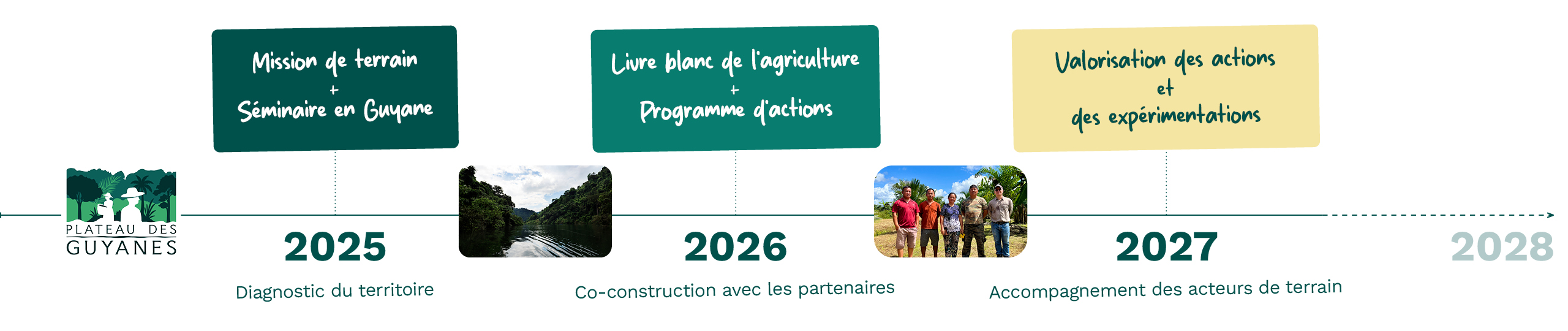
To achieve this, the Foundation and its partners are undertaking a three-stage approach, planned over approximately three years, starting in 2025:
The first step is a diagnostic phase and a detailed analysis of the challenges and needs of the territory:
- A field mission in French Guiana, to be completed in 2025.
- A seminar, mobilizing a wide variety of actors from the agricultural world, is planned for December 2025 to complete this phase.
The second stage of the project consists of co-constructing solutions with the stakeholders involved in these issues.
- A white paper The report on Guyanese agriculture, establishing the diagnosis and presenting the conclusions of the seminar, will be published during the first quarter of 2026.
- Collective construction of an action plan with a diversity of actors from the agricultural world in order to explore concrete alternatives for sustainable agricultural development.
Finally, the implementation of this action program, starting in 2026, This will constitute the third stage of the project involving support for actors on the ground, and the promotion of actions undertaken with a view to their reproduction and adaptation to new contexts.
The project arose from the combined efforts of local stakeholders. to implement a sustainable development strategy for local agriculture.
With twenty years of experience in promoting sustainable agriculture around the world, and particularly in the countries of the South, the FARM Foundation was naturally approached by SAFER Guyane, which was created in 2017.
SAFER Guyana is the public actor responsible for managing and developing rural land in French Guiana, in order to promote the establishment of farmers and the viability of farms.
The Regional Bank of Crédit Agricole Martinique-Guyane, cooperative and mutual bank, has joined the partnership to support the sustainable development of sectors and the promotion of agricultural professions, as climate change intensifies the risks faced by farmers.
The Chamber of Agriculture of French Guiana recently joined the project. As a field actor, it provides technical support to farmers, represents their concerns and facilitates the implementation of actions in the territory.
The Foundation and its partners need all available support to carry out this project, join our collective!
More information:
- Christian Moreno, Project manager: christian.moreno@fondation-farm.org
Which SDGs does the Plateau des Guianas project contribute to?