Summary of the webinar "Public support and agricultural financing in Africa: what levers to support the transitions?""
In a context of budget cuts, declining international aid and rising climate risks, financing agricultural transitions in Africa is becoming a major issue
The webinar organized on June 30, 2026, by the FARM Foundation, AKADEMIYA2063, and ATLAS demonstrated that the transformation of agri-food systems depends as much on the quality, direction, and monitoring of investments as on their volume. The analyses highlighted three key levers: better targeting of public support, more effective investment through decision-making tools, and mobilizing more private financing, particularly through blended finance. In this context, the Kampala Agenda offers a strategic framework for linking continental commitments, national budgets, and bankable projects.
Sequence 1: mEstimates for better guidance: what the Global Observatory of Public Support reveals
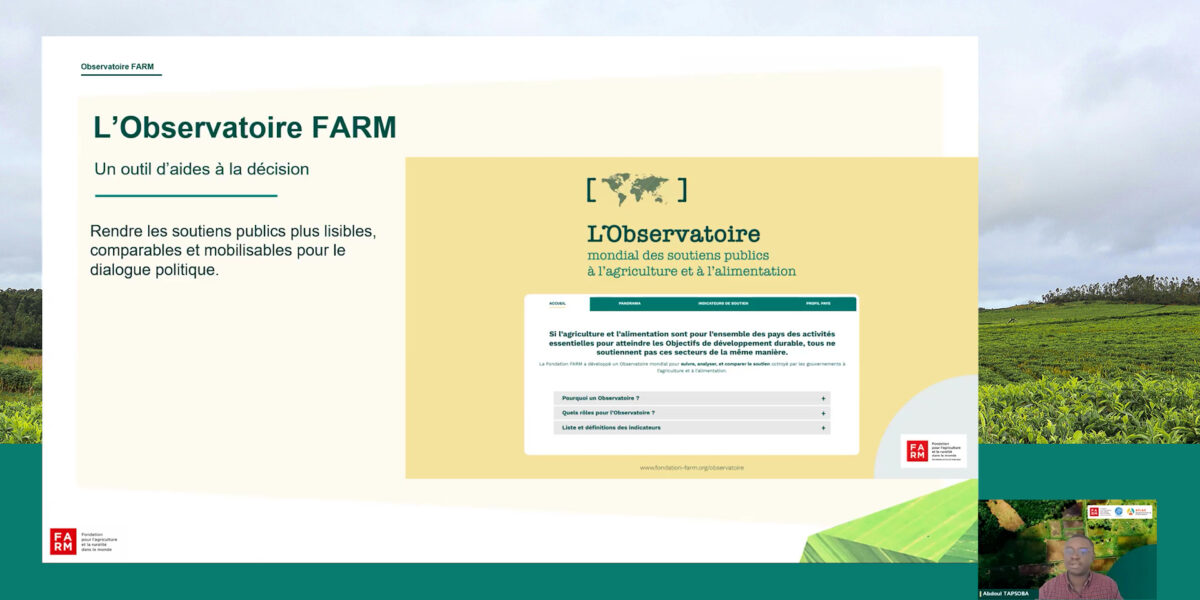
Created in 2018, the Global Observatory of Public Support for Agriculture was designed as a decision-making tool to make public support more transparent, comparable, and readily usable in agricultural policy debates. It now covers 93 countries, representing over 90% of the value of global agricultural production, and allows users to map, compare, and analyze support, now down to contextualized country profiles.
Several lessons were shared by Abdoul Fattath Tapsoba, coordinator of the Observatory:
– on a global scale, a strong concentration of support Over the last three years for which data is available, public support exceeds $542 billion, of which nearly $90 billion is concentrated in four major regions: East Asia, North America, South Asia, and Western Europe. Relative to the value of agricultural production, global support represents approximately $14 billion, but the relative effort varies considerably across regions, reaching a level of around $8 billion in sub-Saharan Africa.
– A specific composition of support in sub-Saharan Africa where they are overwhelmingly directed towards public services, which represent more than 80% of expenditure. These structuring services (irrigation, storage, research, infrastructure, etc.) are essential, but a significant portion also falls under rural development in the broadest sense, without always being directly targeted at agricultural investment.
– A public effort that raises questions. The FAO's agricultural policy index, which compares agriculture's share of public spending to its share of GDP, declined in several countries between the Maputo and Malabo periods. This decline is concerning, especially given that agriculture remains central to employment, food security, and economic and environmental transitions.
– A vulnerability linked to foreign aid In many countries, official development assistance continues to finance a significant portion of agricultural budgets. This dependence makes agricultural policies more vulnerable in a context of shrinking international aid.
This first sequence raises a central question: what support should be preserved, redirected or supplemented to sustainably finance agricultural and food transitions?
Sequence 2: From measurement to action: how to target the most structuring investments?
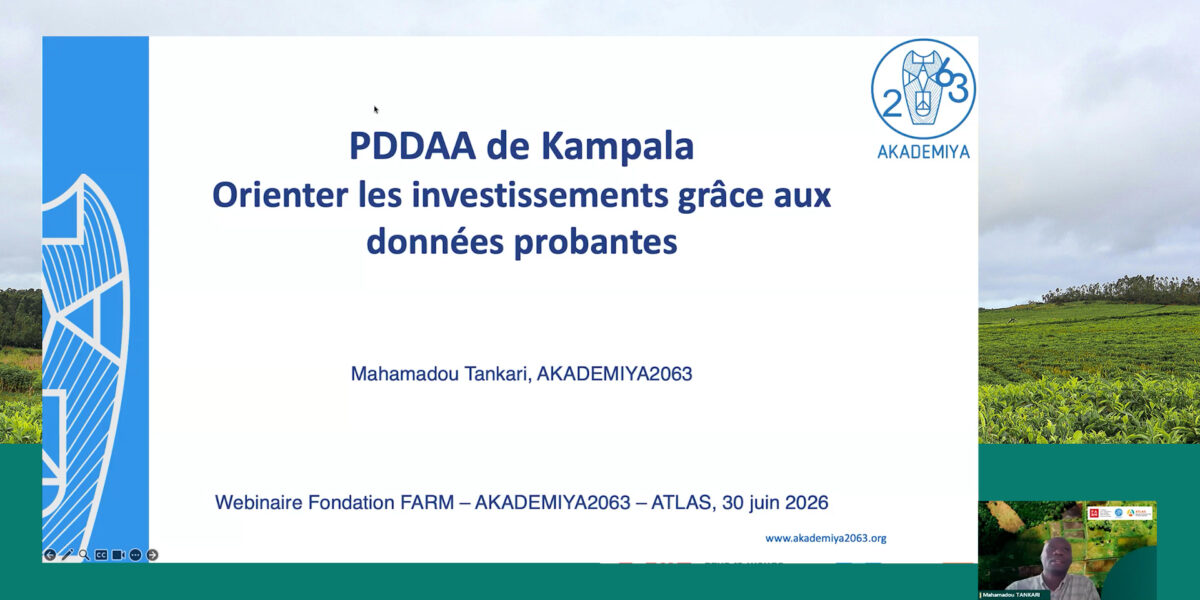
The presentation by AKADEMIYA2063 placed the challenges of agricultural financing within the context of evolving continental commitments, Maputo to Malabo, then to Kampala. While Maputo focused on increasing agricultural investment, Malabo broadened the agenda to include dimensions such as nutrition, inclusion, and resilience. With Kampala, the ambition now lies in transforming agricultural and food systems, integrating agro-industrialization, employment, resilience, and governance.
In a context where investment needs are increasing while public resources remain limited, with many countries remaining below the 10% threshold of public spending, the challenge is no longer just to invest more, but to invest more effectively.
Three priorities were highlighted:
– Better target investments : identify the combinations of sectors and instruments (production, agribusiness, nutrition, research, irrigation, infrastructure, agricultural advice) most likely to produce impacts according to the objectives pursued of growth, employment, poverty reduction, food security or resilience.
– Relying on decision support tools : to mobilize diagnostic analyses and simulation tools to inform investment choices. Examples were presented, notably in Togo on the effects of public spending on poverty reduction, as well as interactive tools already deployed in several countries, including Kenya.
– Strengthen policy coherence : to better coordinate interventions between sectors in order to avoid contradictions and maximize synergies. A diagnostic tool for the coherence of food system policies, developed with partners, makes it possible to assess coordination mechanisms and interactions between public policies.
This sequence demonstrates that the Kampala Agenda marks a shift in scale, moving from an agriculture-centric approach to one that encompasses broader agricultural and food systems. It also underscores the need for more effective investment, supported by evidence-based decision-making and decision-support tools. Finally, policy coherence emerges as a cross-cutting condition for impact.
Sequence 3: Increased funding, but a persistent structural deficit and major cyclical shocks

ATLAS's presentation was based on the second edition of the Agricultural Finance Barometer, which aggregates available data on public, private and philanthropic financing to inform investment decisions in African agri-food systems.
Since 2019, total investment in African agri-food systems has increased from approximately $41 billion to $48 billion, a faster rate of growth than in other sectors on the continent. At this pace, it could reach $58 billion by 2030, a level that is still far below the estimated needs of $100 billion to $200 billion per year. These flows represent only about 3 million TFPs of total investment on the continent, compared to 10 to 12 million TFPs in South Asia or India.
Three main lessons emerge:
– A high geographical concentration The top ten recipient countries attract approximately 60% of investments and up to 75% of private financing. North and West Africa receive the bulk of the flows, while Central and Southern Africa remain less funded.
– A worrying decline in private investment : this has fallen from approximately $23 billion to $22 billion since 2019, which is one of the most worrying signals in the barometer.
– Three major shocks to the financing outlook : the decline in public development aid, estimated at around 18 % globally between 2024 and 2027; the input crisis, linked in particular to dependence on imported fertilizers and the evolution of energy prices; and the rise of climate risks, while agriculture still only captures a limited share of the financing dedicated to adaptation.
This sequence highlights that, despite an increase in agricultural financing, its level, distribution and resilience remain insufficient to meet the transformation needs of agri-food systems.
Roundtable | Public support, blended finance and national plans: an essential combination for transforming agricultural systems
Senegal's perspective: making decisions under pressure, preserving key investments
In a context of severe budgetary constraints, the case of Senegal highlighted the difficulties faced by public authorities in forecasting, particularly due to sometimes late visibility on the resources available to prepare for agricultural campaigns. This constraint tends to prioritize immediate expenditures, especially inputs, to the detriment of more structural investments such as storage., water management[MB2] [AT3] , mechanization, digitalization or agricultural support.
The discussions also highlighted the importance of better targeting public support. Dispersed resources limit their impact on productivity and the transformation of agricultural sectors. The challenge, therefore, is not only to maintain or increase public investment, but also to better direct it towards priority producers, high-potential areas, strategic value chains, and climate adaptation needs.
Regarding mixed finance, the Senegalese example suggests prioritizing simple, transparent, and demonstrable instruments, linked to priority value chains, such as maize, or to collective mechanisms like community agricultural cooperatives. The objective is to facilitate access to financing and reduce market failures, without making the state a substitute for the private sector or a systematic guarantor of risks.
A mixed finance perspective: reducing risk to mobilize private capital
Mixed finance for agriculture relies mainly on credit enhancement instruments (guarantees, first loss coverage, origination incentives) provided on concessional terms by states or donors in order to unlock private capital, mainly from banks.
These mechanisms reduce the perception of risk, with low non-repayment rates (often 5 to 10 per 100,000) and high recovery rates (up to 80 per 100,000). Several examples were cited: Aceli Africa (East Africa), ABI Finance (Uganda), RDF (Ghana), Pass Trust (Tanzania), as well as public agencies such as GIRSAL (Ghana) and NIRSAL (Nigeria). Technical assistance to banks is also crucial for designing products adapted to the seasonality and cash flow cycles of agriculture.
To better reach small producers, microfinance institutions, cooperatives, and fintechs can also play an important role, particularly through alternative credit scoring or micro-leasing of productive assets. Vehicles such as AdOpes (micro-leasing of productive assets) and Emata (climate-smart agricultural fintech in Uganda) supported by Convergence, illustrate these approaches. Finally, a "« strategic blended finance framework »"in six pillars offers governments a guide to integrating blended finance into their private capital mobilization strategies.
Understanding the mechanisms of mixed finance
For readers less familiar with financial jargon
- Mixed finance : a combination of public or philanthropic funds, provided on favorable ("concessional") terms, and private capital, in order to make financeable projects that the private sector would otherwise consider too risky or unprofitable, in this case agriculture.
- Credit enhancement: A set of tools that improve the risk profile of a loan to give confidence to the private lender and encourage them to finance a sector they usually avoid.
- Guarantee : A third party (the state or a lender) agrees to repay all or part of the loan if the borrower defaults. The bank's risk of loss decreases, and therefore its reluctance to lend also decreases.
- First-loss cover: A public or philanthropic fund absorbs the initial losses on a loan portfolio before the bank is affected. The bank is only exposed beyond a certain threshold.
- Origination incentive: A sum paid to the bank as a reward each time it grants a new loan to the target company (for example, an agri-food SME). "Origination" refers to the act of creating a loan (finding the borrower, preparing and disbursing the loan). The incentive acts upstream, to trigger the lending decision, whereas guarantees and first-loss coverage act downstream, to protect the lender in case of default.
- Technical support: support (training, advice) to banks to design products adapted to the seasonality and cash flow cycles of agriculture.
Continental perspective: from Maputo to Kampala: towards national investment platforms
From Maputo to Kampala, the agenda of PDDAA has gradually structured African agricultural policies around common objectives, initially focused on production, productivity, and the commitment of states to dedicate 10% of their public spending to agriculture. Above all, it has strengthened agricultural planning through national and regional investment plans, with several countries successfully mobilizing funding and initiating its implementation.
A key lesson is that plans only produce results when they are effectively linked to national budgets. It is on this point that the Kampala Agenda introduces a significant step forward: beyond the political declaration, it includes an action plan and implementation tools designed to facilitate the operationalization of commitments.
This new phase reinforces the emphasis on multisectoral coordination, tailored to the realities of each country, analytical studies, the prioritization of a few bankable projects, and the strengthening of accountability as a tool for improving public policies. In this context, the commitment of the 10 % public spending targets should be considered a catalytic lever for mobilizing more private, concessional, and climate-related financing.
Hamady Diop also emphasized the importance of better accounting for informal private financing, which is still largely underestimated in statistics, as well as the tensions between trade liberalization, particularly within the framework of the AfCFTA, and the protection of small-scale producers. The example of Mali was cited as an illustration of the importance of strong political decision-making to advance agricultural priorities.
Conclusion: Transforming commitments into credible investments: the central challenge of agricultural transitions
In closing, several key lessons were highlighted. The first is that the challenge lies not only in the volume of resources mobilized, but also in the ability to translate agricultural priorities into credible, implementable, and sustainable investments. The example of Rwanda was cited to underscore the importance of strong inter-ministerial coordination in the implementation of agricultural policies.
From this perspective, the Kampala Agenda appears as an opportunity to transform agricultural plans into genuine national investment platforms, capable of mobilizing public, private, climate-related, and concessional financing (as exemplified by the investment guide and the GIRSAL mechanism in Ghana). It also calls for recognizing agri-food systems as an engine of economic development, extending beyond mere agricultural production (as exemplified by Ethiopia).
Finally, accountability is not just about measuring results, but also about using them to adjust public policies (as exemplified by the ECOWAS agricultural policy review). The success of Kampala will therefore depend on the collective ability to transform commitments into quality investments, producing tangible results for African producers, agribusinesses, and consumers.
Key messages to remember
- Beyond volume, quality, direction and monitoring of investments determine the transformation of African agri-food systems.
- The Kampala Agenda opens a window to link continental commitments, national budgets and private funding.
- Under severe constraints, public support must be better targeted towards public goods and resilience levers.
- Reliable data, bankable projects and institutional coordination are the prerequisites for blended finance.
- The 10,% of public spending becomes a catalytic resource to mobilize $100 billion in private financing by 2035.