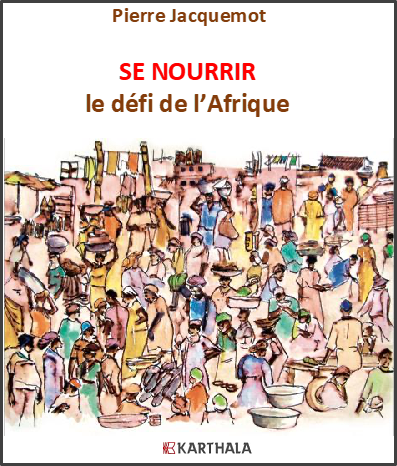
Feeding itself, Africa's challenge
On the occasion of the release of his latest work and with his rich field experience, Pierre Jacquemot[1] returns to the complex equation that African countries, and the world, will have to face by 2050: responding to increasing food demand, under climate constraints and on degraded land without worsening macroeconomic balances. The answer, according to the diplomat, comes down to reinventing agricultural and food policies by putting peasant knowledge, "eating local" and the promotion of regional value chains at the center.
In 2023, it was estimated that 342 million people were experiencing severe food insecurity, meaning they lacked access to adequate food. By 2050, 60% of the world's population growth will occur in Africa, and this continent will be the only one whose rural population will have continued to grow (+35%). The continent will then have to meet the food demand for 2.5 billion Africans, more than double what it is today. This challenge amounts to solving a particularly complex equation: how to meet the growing and evolving demand for sufficient quantities of healthy and nutritious food, given land constraints and climate risks, on often degraded land, while preserving the environment and without increasing dependence on imports?
"Africa produces what it does not eat and eats what it does not produce!" - a simplistic adage to be thrown out the window!
The concept of food sovereignty[2] is put forward in the vast majority of countries. Food sovereignty encompasses the notion of food safety which highlights access, availability and quality of food, and gives it a larger operational dimension (how to achieve it), territorial (if possible everywhere in the country or region), political (on an independent basis) and legal (with a right for all). It carries the idea of the structural transformation of agricultural and food systems, from the supply of inputs to the production of agriculture, fisheries and livestock, to processing up to the retail sale and consumption of healthy and quality food.
In order to contribute to the reflection, but also to suggest possible solutions, several questions guided the writing of the book. Feeding ourselves: Africa's challenge :
- What are the major trends that are likely to continue and that will shape the future of food systems?
- What are the seeds of change that could influence these trends?
- Which agents are potentially the most dynamic, capable of bringing about the necessary transformation?
- With what agronomic, technical and financial options?
- With what responses to demographic and spatial challenges, particularly those associated with rapid urbanization?
- What levers of action can be used to mitigate vulnerabilities to the various shocks (climate, health, security, etc.) that food systems will experience?
Reinventing agricultural and food policies in Africa
The reinvention of agricultural and food policies cannot be achieved without shifting the agricultural trajectory that has been mapped out in Africa for decades. It will require a disruption in water, soil, seed, nutrient, and other resource management practices to boost the adaptive capacity of agriculture, fisheries, and livestock production. In these areas, no transformation approach is complete without a long-term vision.
What directions should guide the continent's food sovereignty strategy? Placing the peasant economy and its crucial functions, as well as its unique knowledge, at its core can positively influence the conditions for meeting both rural and urban food needs. This echoes the demands of many farmers' associations: the transition to resilient food systems will require a focus on equity, social well-being, and the inclusion of farmers and communities in the design and implementation of locally appropriate solutions.
Intensifying production is not an option; it is a requirement.
How can we double agricultural, fishery, and livestock production by 2050? Land limitations are evident. Our estimate is for an increase in actual availability under acceptable yield conditions of around 50 to 100 million hectares. Hardly more. Practices combining diversification and intensification will yield the best results. African agriculture already has a fairly broad spectrum of solutions, either alternative or complementary, borrowing from one, the other, or even all three models (conventional, transgenic, agroecological). The potential of combining genetic engineering and ecological engineering is significant for building "ecologically intensive agriculture." This will be done with new techniques, the proliferation of which is already impressive, whether these relate to agroecological routes or to the transformation of products to encourage "local consumption" into nutritious and healthy products of quality and accessible to the greatest number, and thus combat the triple burden of malnutrition (food deficiency, nutrient deficiency, obesity).
The adoption of imported food consumption patterns as urbanization progresses is not inevitable. Urban consumers will, as is already the trend, increasingly need products that are quick to consume and easier to use, often requiring at least one processing step between the field and the consumer's shopping basket. It is important that the share of unhealthy and ultra-processed foods be limited as much as possible through policy measures. Developing a network of artisanal or industrial processing businesses that source their ingredients locally will require intensified support and investment initiatives.
Conquer local eating with local produce
"Changes under constraints" can benefit the consumption of local foodstuffs. Sustainably shifting dietary habits by, for example, substituting millet and sorghum for imported cereals in Sahelian countries or by increasing the consumption of legumes is no longer an insurmountable obstacle. Thanks to the ingenuity demonstrated particularly by women, certain local starchy foods are gaining a foothold in the "eat local" movement: dried cereals and plantains, and legumes that can contain significant amounts of protein and calories. These products must incorporate the qualities appreciated in imported products (taste, appearance, ease of preparation), but also take into account local "food culture," of which women are still the guardians within households and communities. Applied research has an opportunity to seize if it is based on surveys of dietary behaviors leading to relevant advertising themes and if it involves local artisans and businesses in the processing.
Investing to address the “first mile” while protecting markets
The need for improved rural transport infrastructure in sub-Saharan Africa is urgent and evident. Rural transport strategies all share the same objectives: to address the "first mile" constraint in transporting agricultural products from the farm; and to ensure the effective management of the "last mile," because that is when... product THE contact with end customers; increase resilience to climate hazards, particularly through the improvement of roads in rural areas; implement effective systems for maintaining tracks and roads…
Border protection is structural if it is well designed and well targeted. There is no shortage of arguments for a reasoned increase in customs duties on agricultural products in Africa, at least to the level of safeguard measures for sensitive products authorized by the WTO: reducing competition from low-cost imports to strengthen local value chains, reducing the trade deficit, reducing food dependence on global markets. And eliminating the "import rents" enjoyed by many large traders.
Given the diversity of African agriculture, the rationale for integrating regional markets seems self-evident. The regional level will be relevant for thinking about the future. Expectations are high, and there is significant room for growth in trade within the continent. Growing regional demand for quality food products will provide an opportunity to drive sustainable transformation of the agri-food sector. Creating regional value chains (RVCs) can become a realistic goal. It meets three objectives: capitalizing on complementarities between countries and economic actors in the region, harnessing the growing demand for fresh and processed food products, and protecting against distortions transmitted by international markets.
Experience shows that coherence between short-term responses to recurring or exceptional crises and long-term transformational changes must be central to policy. For a long time, the right hand (support for cereal production) was unaware of what the left hand (issuing import licenses) was doing. The contradictory nature of a proactive policy to develop local production, while simultaneously remaining under the influence of rent-seeking importers, illustrates the dilemma faced by political powers virtually everywhere, oscillating between protecting the interests of rural producers and liberalizing imports. Nevertheless, the levers for structural transformation are within reach of African leaders, provided they allow the multitude of initiatives to unfold and facilitate their flourishing, with women seeking autonomy and young people seeking integration at the forefront.
One reality is clear: Africa is plural.
Not all actors and actresses are locked in the same way into the constraints of their ecosystem and inserted in the same way into the market system. There is nothing comparable between the Africa of the argan tree and the olive tree of Morocco, the Africa of the granaries and the daba of Burkina Faso, the Africa of banana trees and euphorbias of the Great Lakes, the Africa of the vast irrigated plains of Egypt or that of the Malagasy tiered rice cultivations… Based on this observation of diversity, the analysis of agricultural and food systems leads to the existence of no less than fifteen different major systems in sub-Saharan Africa and eight systems in North Africa. Each of these systems includes millions of agricultural households with contrasting levels of resources, access to services and adaptation strategies. Faced with such diverse realities, the approach suggested in this book is to highlight the heterogeneity and richness of practices, the multiple and sometimes paradoxical nature of the logics that govern the action of actors, even if the exercise of synthesis sometimes requires a certain form of generalization.
[1] A diplomat and academic, honorary president of the Initiatives Group, expert at the Jean Jaurès Foundation, lecturer at the Paris Institute of Political Studies, and member of the Academy of Overseas Sciences, Pierre Jacquemot served successively in Senegal, Algeria, Burkina Faso, Cameroon, Kenya, Ghana, and the Democratic Republic of Congo.
[2] See the article on this subject on the FARM Foundation website Food security, food sovereignty: understanding everything, August 2022.