Pesticides in agriculture: understanding the issues
The use of pesticides in agriculture represents a major and complex issue worldwide. These substances have been designed and deployed to improve crop productivity and health, but their use is increasingly controversial. What pesticides are used in agriculture? What are the consequences of their use? The FARM Foundation offers insights and answers to these questions.
Definition and role of pesticides
The word "pesticide" is a generic term derived from the Latin terms " caedere » (kill) and « pestis » (scourge). It covers various definitions depending on the contexts of use and regulations. For the European Commission[1], in the agricultural sector these are products which aim to destroy, prevent or control the presence of living beings harmful to a plant or agricultural commodity. Their use should improve crop yield and quality by reducing losses caused by harmful organisms. They are also called plant protection products or phytosanitary products.
Pesticides can also be used on products after harvest, to improve the long-term preservation capacity of these products, as is the case, for example, for the storage and transport of cereals.[2].
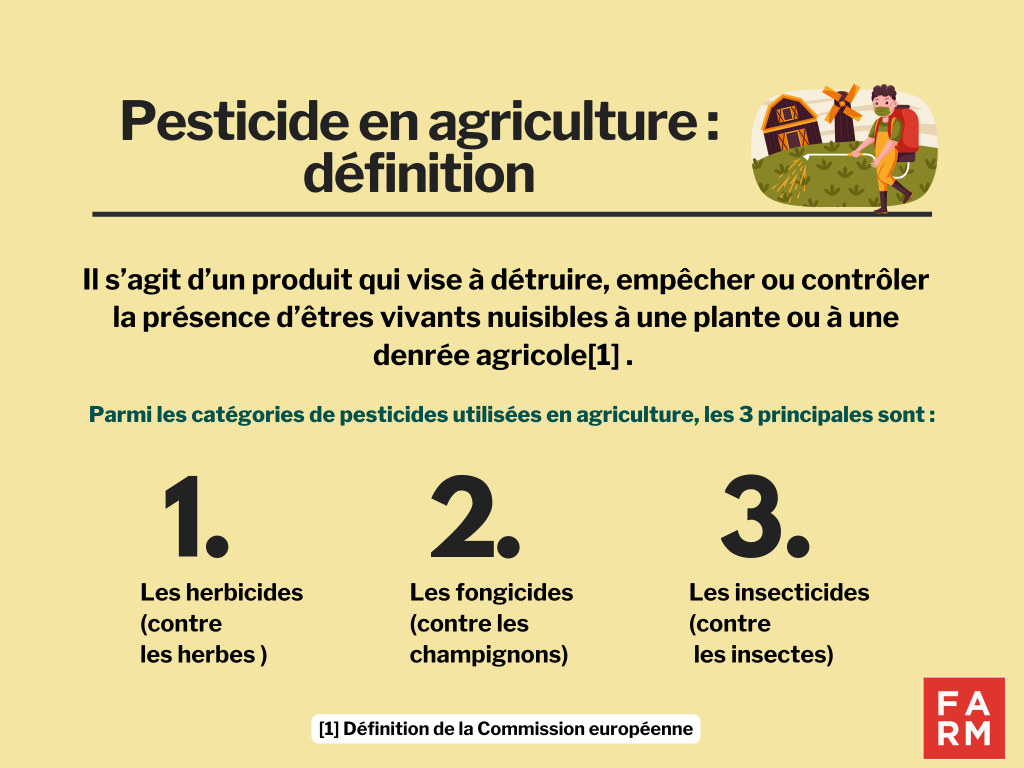
We can distinguish several categories of pesticides used in agriculture, depending on the different targets. Among the most used, we can cite the herbicides which attack unwanted plants, fungicides to fight against fungi and insecticides. Their operating principle relies on one or more molecules – the active substances – contained in the product. These substances act chemically on the metabolism of the parasites or plants they target, causing their death.
Some substances are highly selective, acting only on very specific species or varieties. Others have a broader spectrum of targets. Glyphosate, for example, is an active ingredient that kills all plants. It is then referred to as a total herbicide.
Active substances can be derived from synthetic chemistry or a natural process. essential oils, for example, fall into the category of biopesticidesThese products are part of a more integrated approach to plant protection that aims to disrupt ecosystems less.[3]. They represent today less than 10 % of the pesticide market.
What is the use of pesticides in agriculture?
The history of crop protection dates back to the very origins of agriculture.. Since humans first became farmers around 10,000 years ago, they have had to defend their crops against insects, diseases, competing plants, and adverse weather conditions. More than 7,000 years later, in Antiquity, the Greeks, for example, used... sulfur as a fumigation agent to protect crops. Over the centuries, other natural substances (arsenic, aconite, nicotine or rotenone) have been used to fight against pests and diseases.
Before the rise of synthetic chemistry, farmers combined the use of natural substances with ecosystem services (i.e., services provided by nature) and agricultural practices to protect their crops. For example, crop associations in time and space (crop rotation) limited the spread of diseases, while crop diversification reduced pest pressure.
International trade was much more limited than it is today, reducing the spread of pests and pathogens. Lower planting densities, and therefore more widely spaced plantings, made possible by less population and land pressure, also slowed the transmission of diseases between plants. These practices, which are not exhaustive, illustrate the complementarity and the need to combine diverse agricultural strategies to ensure crop protection.
However, the techniques used proved insufficient to manage health and climate-related risks. This was notably the case in 1845, when Ireland suffered the worst famine in its history. Phytophthora infestans, The potato blight agent devastated crops. Between 1845 and 1852, more than a million people died of starvation and two million emigrated, reducing the country's population by a third. A catastrophe of a scale difficult to imagine today, caused by a fungus.
The use of pesticides only became widespread at the end of the 19th century., With the progress of mineral chemistry: copper salts, mercury or Bordeaux mixture then became references in terms of fungicides. A new stage was reached in the 1930s With the rise of synthetic organic chemistry, the first modern pesticides appeared, notably organochlorines. DDT, synthesized in 1939, thus became the dominant insecticide until the 1970s. THE two world wars have also been incubators for the development of synthetic organic chemistry.
For over sixty years, the use of pesticides has been a key practice in agricultural intensification. Easily accessible and relatively inexpensive compared to the productivity gains they provided, they proved effective in contributing, alongside other factors such as genetics and irrigation, to increased and consistent yields over large areas.[4].
Responding to a growing demand for agricultural products, this model has spread throughout developed countries and in some developing countries (for example, the cereal sectors in Asia and Latin America and the cotton sector in Sahelian Africa).
Today, more than 800 active substances are available on the market and global consumption of pesticides in agriculture exceeds 3 million tonnes per year.[5].
The effects of pesticide use on biodiversity, ecosystem services, and human health have been the subject of much controversy since the pioneering work of Rachel Carson in her book Silent Spring published in 1962. The American biologist and activist denounces what she calls the "pesticide scandal".« which will lead to a ban on DDT in the United States.
The relationship between pesticide use and the erosion of ecosystem services is, today, widely documented Some active substances present proven risks to human health and the environment. Several recent studies attest to this.[6][7] : the use of hazardous pesticides is among the factors contributing to exceeding at least one of the nine “planetary boundaries” : that relating to the introduction of new entities into the biosphere. The work of the Stockholm Convention illustrates this phenomenon by highlighting the global dispersion of chlorpyrifos, the presence of which is detected in ice cores extracted from a depth of 125 meters in Svalbard, or in sediment samples taken from the Tibetan Plateau, far from their original area of application.
Farmers are now trying to move away from this agricultural model because of its impacts on human health and ecosystems. Producers in organic farming[8] do indeed do without synthetic pesticides. But, they do not necessarily do without pesticides. For example, to fight against certain diseases such as vine mildew or potato, they still remain dependent on the use of copper, excess of which has very harmful effects on soil life[9]Another model occupies significant areas worldwide. : soil conservation agriculture[10].
This technique is being developed for large-scale farming in the Americas and Australia, and is also gaining ground in Europe, Asia, and Africa. It involves no-till farming, covering the soil, and diversifying crops to maintain soil fertility and biodiversity. This concept, which promotes soil function and its biological regulation, effectively reduces reliance on fungicides and insecticides. However, total herbicides, such as glyphosate, are still commonly used to control weeds.
These agricultural practices that reduce pesticide use are therefore not immune to the challenges posed by the use of these products..
Uses vary greatly depending on the culture
Pesticide use is linked to crop types and local cultivation practices. Regions where large-scale crops (corn, soybeans, wheat, etc.) predominate, such as the United States, are heavy users of herbicides. Fruit growers use more fungicides such as copper or sulfur.
Most of the time, The quantity of pesticides used is determined by the degree of pressure that pests can exert on crops.. Their presence and development are influenced by climatic conditions (humidity, temperature). The growing environment and the richness of the ecosystem within cultivated plots also play an important role in promoting or regulating their presence. Cultivated varieties themselves vary in their susceptibility to disease.
It should be noted that under certain conditions of use, insects, fungi, or unwanted plants can become resistant to plant protection products. This loss of effectiveness of the molecules leads to a gradual increase in the doses used by farmers and the creation of new pesticides by manufacturers.
Global overview of chemical pesticides
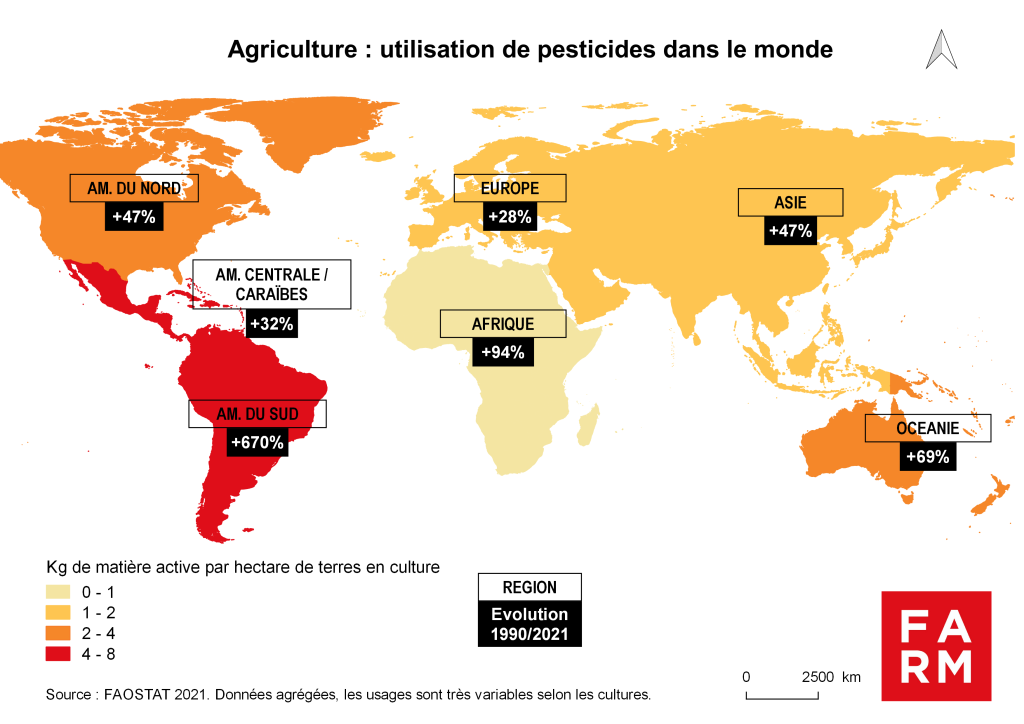
In 2021, global pesticide consumption reached 3.5 million tonnes of active ingredient, or an average of 2.26 kg per hectare of agricultural land. Herbicides are the most widely used category of active substances and represent almost half of this volume.
Pesticide consumption has nearly doubled worldwide since 1990[11]However, this underlying trend masks a very large geographical heterogeneity.Africa uses 11 times less per agricultural hectare than South America and 5 times less than the European Union.[12]. In France, where usage is increasingly regulated, Wheat crops are treated on average 7 times a year, banana plantations in the Antilles 8 times a year and apple orchards receive an average of 36 treatments per year[13]. To explain these significant disparities and their evolution, a quantitative analysis at finer scales (such as that of sectors) would undoubtedly be rich in lessons. But this data is unfortunately still very fragmentary.
The global pesticide market is today dominated by 4 large companies based in Europe and the United States : Syngenta Group, Bayer, Corteva and BASF. In 2018, they controlled approximately 70 % of the global pesticide market[14], whose growth is driven by the development of sales in South America, Southeast Asia and Africa.
What are the consequences of using pesticides?
Producers, agricultural workers and rural populations living in production areas are among those most exposed to pesticides.[15]Frequent handling of chemicals can cause health problems. Health effects can be immediate, such as skin reactions or respiratory problems. Chronic effects, which appear over the longer term, are also observed.[16]Several epidemiological studies conclude that there is a strong presumption of links between exposure to pesticides and the occurrence of cancers or reproductive disorders.[17]This is the case, for example, among agricultural workers on banana farms in the Antilles exposed to chlordecone.[18].
While farmers are the most exposed, pesticides also pose risks to other segments of the population.. Indeed, toxic molecules are transported by wind and water and generally do not remain where they have been applied. By persisting in the environment for many years, they contaminate the water and soil.[19] and risk ending up in the food consumed.
Some countries, such as France, have implemented controls on residues of toxic molecules in food products. Approximately 4,130 of the tests carried out in 2017 revealed the presence of a molecule banned in France.[20]. Such a control system provides a certain level of security for consumers, but it remains limited since only certain known molecules are analyzed. It should be noted that this type of control system remains little used, if at all, in southern countries.
The effects of pesticides on the environment are also being highlighted by civil society and researchers.. The molecules eventually degrade, sometimes after several decades, but some residues persist in the environment. The case of chlordecone is a prime example.[21]. This insecticide was notably used for about twenty years in banana plantations in Martinique and Guadeloupe. It was banned in 1993 because it was considered dangerous to human health. Its use led to chronic soil and water pollution. Thirty years later, the food chain and the local population are still contaminated.
This example illustrates the difficulties faced by public authorities when authorizing or prohibiting the marketing of these products or regulating their use. It can sometimes take a long time to measure the chronic impacts on health and the environment. This timescale is hardly compatible with the rapid pace at which new chemical pesticides are being developed. Furthermore, regulations regarding permits or uses vary greatly from country to country.
Many active ingredients are banned within the European Union, but European manufacturers can still produce and export them to third countries, or import products containing residues of them. In the absence of international regulations, national and regional positions are sometimes contradictory, making a harmonized and effective regulatory approach difficult.
In conclusion
While pesticides undeniably play a central role in global agriculture, their use is nonetheless a controversial issue. Some argue that they make a vital contribution to global food security, while others see their negative effects on the environment and the health of humans and ecosystems. This market, with significant potential, attracts manufacturers, but scientists and public authorities lack the time and resources to study the risks.
Crop diseases and pests pose a significant threat to the agricultural sector, on which millions of smallholder farmers depend for their incomes and livelihoods, and to global food security. Finding the right balance is a particularly complex challenge on the path to more sustainable agriculture.
[2] Control of phytosanitary products (pesticides): treatment of stored foodstuffs (Ministry of Agriculture and Food Sovereignty)) ; France to reverse ban on insecticide to protect grain exports (francetvinfo.fr)
[3] Integrated protection: principles and definitions | Ministry of Agriculture and Food Sovereignty
[4] Over the period 1961-2021, wheat yield in Western Europe increased from 2.6 to 7.0 tonnes per hectare (+169%), and corn yield in the USA increased from 3.9 to 11.1 tonnes per hectare (+184%) (Source FAO).
[5] FAO data (2019)
[6] Vandenberg LN, Pierce EJ, Arsenault RM. Pesticides, an urgent challenge to global environmental health and planetary boundaries. Front Toxicol. 2025 Oct 3;7:1656297. doi: 10.3389/ftox.2025.1656297. PMID: 41114400; PMCID: PMC12531173.
[7] Sofie te Wierik, S., DeClerck, F., Beusen, A. et al. Identifying the safe operating space for food systems. Nat Food 6, 1153–1163 (2025). https://doi.org/10.1038/s43016-025-01252-6
[8] According to the FAO, organic farming involves 3 million producers who cultivate 74 million hectares (The World of Organic Agriculture 2021 | FAO) – on 4.7 billion hectares cultivated in the world.
[9] Karimi et al., 2021, Response to comments by Imfeld et al. on the article 'Is soil biodiversity impacted by copper input or accumulation in vineyard soils? Synthesis of scientific knowledge' by Karimi et al.
[10] Conservation agriculture represents 12.5% of global agricultural land, and 68% in South America (Kassam et al., 2022,
Successful Experiences and Lessons from Conservation Agriculture Worldwide)
[13]Agreste surveys on cultural practices in arboriculture in 2018 and in large crops in 2017Between 2012 and 2018, the change in the average number of treatments on apples was not significant; however, the treatment frequency index (TFI – which indicates the number of pesticide doses used per hectare) decreased. For bananas, the average number of treatments decreased but the TFI remained stable. For soft wheat, there was an increase in the average number of treatments and the TFI over the period 2011-2017.
[14] The problem with growing corporate concentration and power in the global food system | Nature Food
[15] Sources of exposure to pesticides – Ministry of Health and Prevention (sante.gouv.fr)
[16] See for example the study by Tiembré et al., 2016. Environmental and health impact of pesticide use in urban and peri-urban market gardening in the Yamoussoukro area, Ivory Coast
[17] INSERM report, 2021, Pesticides and health effects.
[18] INSERM, 2021, p55
[19] Ministry of Ecological Transition, 2020, France's environmental assessment – Pollution of surface and groundwater ; And
Silva et al., 2019, Pesticide residues in European agricultural soils – A hidden reality unfolded.
[20] Control of pesticide residues in plant foods in 2017 | economie.gouv.fr
[21] INSERM, 2021
Un commentaire sur “Les pesticides en agriculture : comprendre les enjeux”
Leave a Reply
You must be logged in to post a comment.
First of all, I would like to commend the quality of this article, which is very well-documented and balanced.
I only regret that the concrete alternatives and technical routes, allowing us to effectively reduce the use of crop protection products, are not described in more detail.
There are many simple, common-sense solutions.
Working for a generic manufacturer of phytosanitary products in Central and West Africa (the region of the world where the quantity consumed per hectare is the lowest), I am also fortunate to work for shareholders who do not impose a volume logic on us. They define our mission in a very simple and non-dogmatic way: to enable small producers to protect their future harvest at an affordable cost (meaning economic, social, health, environmental).
Curiously, the people with whom we have the most difficulty promoting common sense rules (such as the right product in the right dose in the right place at the right time) are the users, and not always the poorest, the youngest or the least educated...
For example, we have been able to demonstrate for more than 10 years (and we are not the only ones) that certain treatments can be spaced out or eliminated, in particular through the use of biostimulants such as mycorrhizae: our biggest detractors are certain research institutes and certain managers of large plantations, who nevertheless have every interest in moving in this direction.
The same people who sometimes recommend using truckloads of mineral oil against banana leaf spot, claiming it's organic.
Your article lays the foundations for a balanced, non-partisan reflection: let us hope that the subject is not hijacked by the most learned, who are not always the most agile and who lead us to believe that the interest of all phytosanitary companies is short-term.
Sincerely
Guy DEBRAY
guy.debray@savana-france.com