The FARM Foundation Observatory: understanding, comparing and guiding agricultural policies
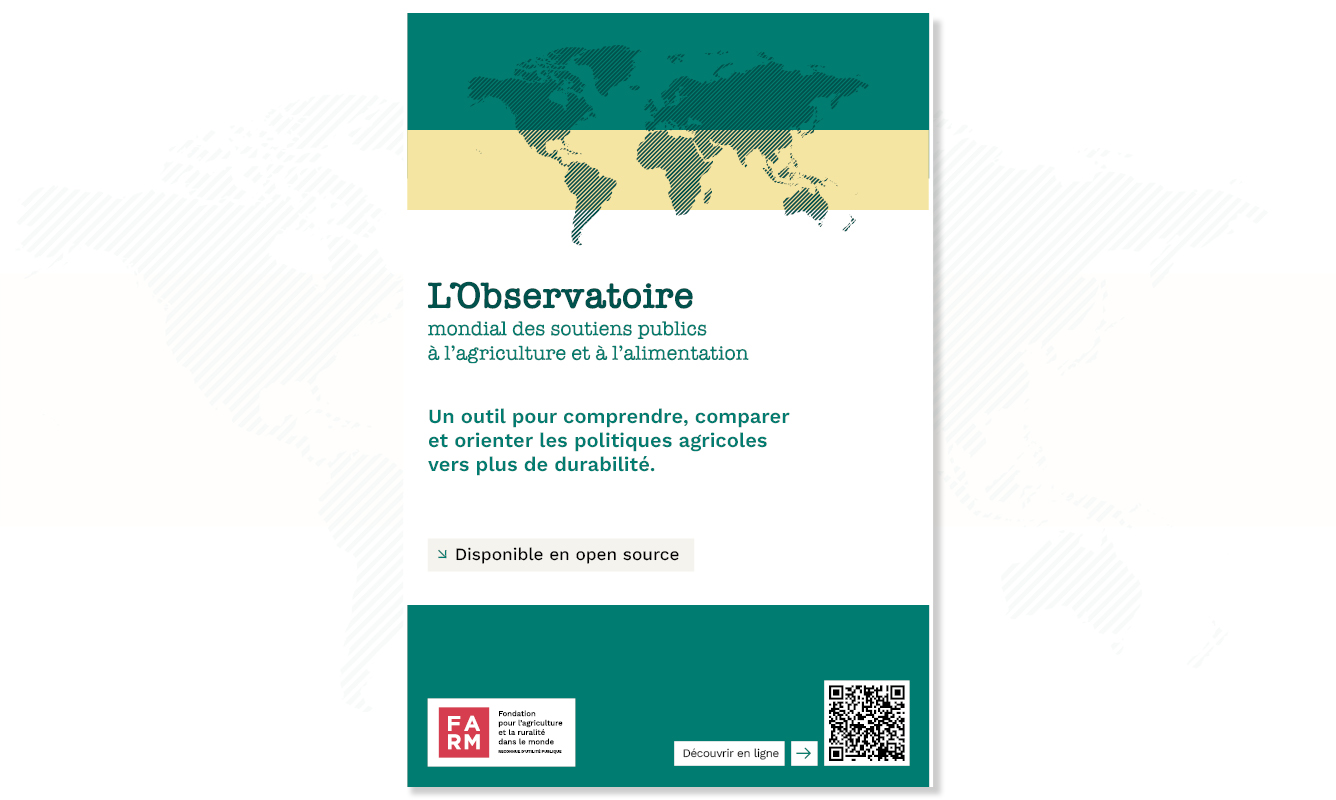
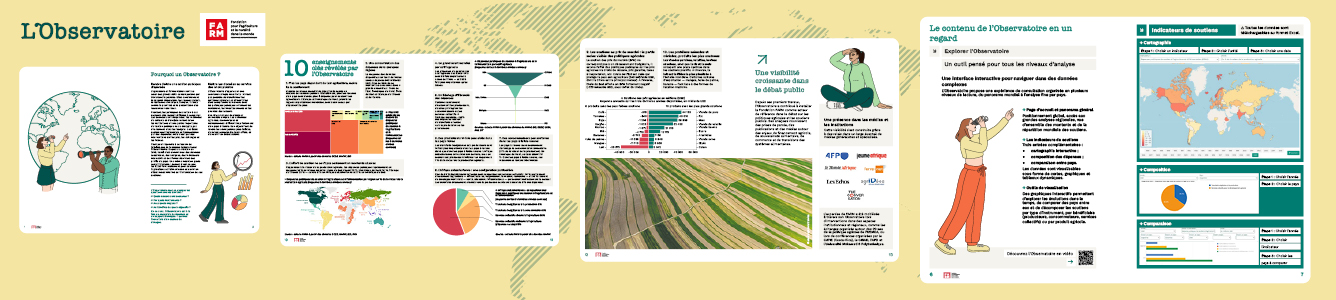
The FARM Foundation publishes the presentation brochure for its Observatory, in French and English.
Available as open source, the Observatory is a tool to understand, compare and guide agricultural policies towards greater sustainability.
🧭 Why an Observatory?
Policies to support agriculture and food remain difficult to compare Data is scattered, collection and analysis methods vary across institutions, and a significant portion of public action is not directly reflected in budgets. It is to address this need for transparency that the FARM Foundation launched the Observatory in 2018.
His actions are guided by the same intention. : to show what states are actually doing to support agriculture and food, and to open a more informed debate on the direction of this support.
- Which actors are being supported?
- By what instruments?
- With what resources?
- For what purpose?
🔎 The Observatory at a glance
representing together more 90 % of the value of global agricultural production, with available series of 1986 to 2022.
THE public support spending to agriculture and food, the market price support (SPM) and the Total support.
in particular the Organisation for Economic Co-operation and Development (OECD), the Inter-American Development Bank (BID) and the program MAFAP (Monitoring and Analysing Food and Agricultural Policies) of the Food and Agriculture Organization of the United Nations (FAO).
supported by the FARM Foundation team in complete transparency, from source verification to data interpretation.
of global overview detailed country-by-country analysis: mapping interactive, composition expenses, comparison between countries and Country profiles.
(last updated in 2024), all downloadable in format Excel.
🎯 In concrete terms, what is the purpose of the Observatory?
The Observatory was designed to be useful to a diverse range of actors, from public decision-makers to citizens engaged in agricultural issues.
For example :
- Public decision-makers (ministries, agencies, regional institutions) place national policies in an international context, identify budgetary priorities and understand the composition of support.
- Funders and technical partners They find in this the means to guide funding, facilitate dialogue with states and coordinate their interventions with national policies.
- Agricultural professional organizations They use it to understand public choices, formulate priorities and inform their advocacy.
Businesses, students and researchers, media and engaged citizens also have access to reliable data to analyze, inform and contribute to the debate.
🏛️ A contribution to the public debate
Since its initial work, the Observatory has fostered discussions on agricultural policies and public support, complementing existing initiatives.
" By recalling that Northern countries devote approximately 20 % of support to their agriculture, relative to added value, compared to 4 to 5 % for Southern countries, FARM informs the thinking of decision-makers and contributes to the debate without replacing public decision-making. »
— Kako Nubukpo, Commissioner of the West African Economic and Monetary Union (UEMOA) in charge of agriculture (2021–2024)
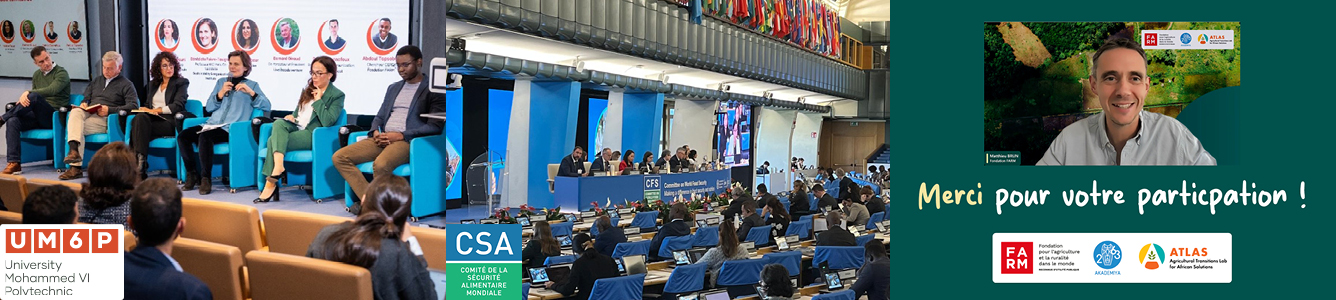
The Observatory was presented on October 22, 2026, in Rome, at FAO headquarters, during the Committee on World Food Security (CFS). FARM's expertise was also mobilized during the 20th anniversary of the WAEMU agricultural policy and at conferences of the Tropical Agronomic Research and Teaching Center (CATIE, Costa Rica), the Center for International Cooperation in Agricultural Research for Development (CIRAD), the French Development Agency (AFD), and Mohammed VI Polytechnic University.
His analyses are relayed by Agence France-Presse (AFP), Le Monde Afrique, Jeune Afrique, Les Echos and The Conversation, as well as by specialized media such as Terre-net and agriDées.
Launched in 2026, the Country Profiles democratize the use of the tool among an ever-wider audience, which is interested in these issues.
In 2025, the Foundation forged two strategic alliances, with AKADEMIYA2063, a pan-African think tank for agricultural policy research, and with ATLAS (Agricultural Transitions Lab for African Solutions).
🎤 Invite the FARM team to intervene !
In a move to serve the public interest, the FARM Foundation team travels to present the Observatory at your conferences, roundtables, webinars or institutional meetings., in French as well as in English.
Some examples or themes for interventions at your events:
Public support spending exceeds USD 542 billion annually, of which nearly 90% is concentrated in East Asia, North America, South Asia, and Western and Central Europe.
East Asia comes out on top (USD 243 billion in market price support, driven by China), while South Asia shows strongly negative support (USD −120 billion).
The more countries depend on their agriculture, the less they support it: in sub-Saharan Africa, public spending represents 8 % of the value of agricultural production, compared to 14 % on average worldwide.
Support spending per agricultural asset is 2,690 times greater in the United States than in Ghana.
These themes are based on the 10 key lessons from the brochure and adapt to your audience.
Understanding public support also means better preparing tomorrow's agricultural policies The Observatory is entirely open source., share it with your networks and quote him in your work (foundation-farm.org/observatory/home/).
Contact us!
To contribute to the tool:
- Abdoul Fattath Tapsoba, project manager (abdoul.tapsoba@fondation-farm.org)
For public intervention or partnership:
- Virginie Percevaux, Director of Sponsorship, Communication and Partnerships (virginie.percevaux@fondation-farm.org)

