The challenges of soil fertility renewal in West Africa: a regional approach and case studies in Benin and Senegal
West Africa is undergoing a period of profound transformation, marked by economic, geopolitical, and climate crises that are undermining food security and sovereignty. The Covid-19 pandemic, Russia's invasion of Ukraine, and more recently, the conflict in the Middle East, have revealed the structural vulnerability of West African agricultural systems, particularly in the face of volatile NPK (nitrogen, phosphorus, potassium) fertilizer prices, which are essential in a context of accelerated soil degradation. Thus, sustainable management and soil fertility restoration are key issues for the resilience of family farms and the sustainability of production systems, in a demographic context where the African population is projected to double by 2050, reflecting the region's growing desire for food sovereignty.
Multifactorial soil degradation
West African soils are structurally fragile: old, poor in organic matter, with low nutrient retention capacity, and susceptible to erosion. Approximately 65% of African agricultural land has suffered degradation since the mid-20th century, 19% of which has been severely degraded. This degradation is primarily due to the intensification of agricultural production systems, the reduction of fallow land driven by population pressure, climate change, and inputs of minerals and organic matter that do not compensate for the nutrients removed by crops.
Traditional soil fertility management practices (slash-and-burn, crop rotation and intercropping, night grazing, agroforestry, etc.) ensured a certain balance in soil fertility renewal. However, these practices are now being challenged by the reduction of available land and land pressure. Furthermore, the use of mineral fertilizers remains very low (15 kg/ha on average in West Africa compared to 120 kg/ha globally). Their effectiveness is further limited by the low organic matter content of the soils, and their availability is threatened by price volatility on international markets.
Mining agriculture and negative nutrient balances
The nutrient balance approach is essential for understanding fertility dynamics. In West Africa, balances are generally negative: nutrient outputs (through crops, leaching, and volatilization) exceed inputs (fertilizers, manure, biological nitrogen fixation, and atmospheric deposition). NPK balances show a deficit, particularly for phosphorus and potassium, leading to a progressive depletion of soil mineral resources. Nutrient use efficiency (NUE) is high for nitrogen, but this primarily reflects under-fertilization rather than effective management. For phosphorus and potassium, NUE levels are very high, indicating excessive use of soil reserves, leading to long-term depletion if these mineral elements are not replenished.
The progressive degradation of mineral resources in the soil, combined with an insufficient supply of organic matter, leads to a decrease in the soil microbial population, resulting in a decline in overall soil productivity and increased degradation.
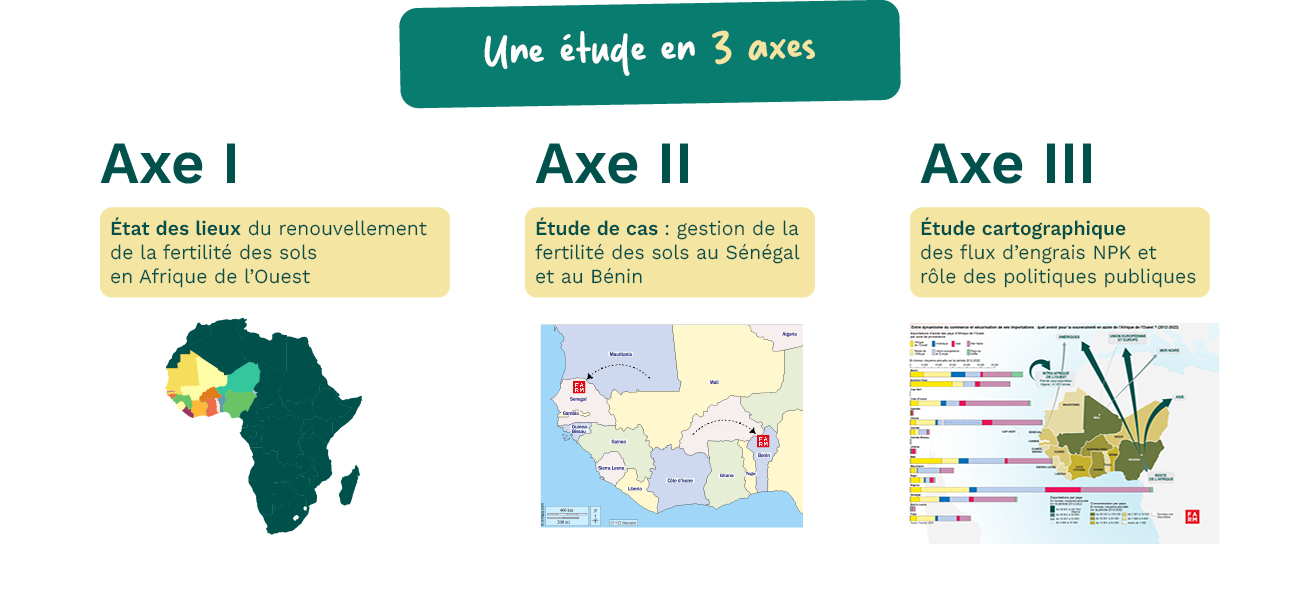
Faced with deficient nutrient balances and multifaceted degradation of West African soils, the combination of organo-mineral fertilization and agroecological practices (composting, agroforestry, crop rotation and association, etc.) is essential to act on all components of soil fertility (chemical, physical and biological), as illustrated by the case studies in Benin and Senegal.
Case studies
The cotton-growing region of Northern Benin:
Traditionally, farming systems relied on slash-and-burn agriculture, fallow periods, and intercropping, ensuring a balance between production and soil fertility renewal through the complementarity of crop and livestock farming. The introduction of cotton as a cash crop and population growth led to an intensification of practices, a reduction in fallow periods, and an increase in soil resource extraction, without sufficient compensation through organic or mineral inputs.
Today, land degradation is characterized by a decline in organic matter and nutrient levels, as well as increased vulnerability to erosion. Fertility management strategies vary depending on farm type but remain limited by land constraints, difficult access to credit, insufficient labor, inadequate mechanization, and a growing separation between crop and livestock farming. Agricultural extension services, often fragmented and under-resourced, struggle to support the transition to more sustainable practices.
In light of these findings, several national and international initiatives encourage crop diversification, the promotion of organic fertilization, the integration of crop and livestock farming, the responsible use of mineral fertilizers, and the development of agroecology (projects supported by international donors such as Tazco, Prosol, etc.). However, scaling up these solutions remains a major challenge to ensure the sustainability of agricultural systems and strengthen the resilience of farms in the face of demographic and environmental challenges.
The Senegalese Groundnut Basin:
During the 20th century, the peanut basin of Senegal transitioned from an agro-sylvo-pastoral system based on fallow land, common grazing, and field trees to more intensive peanut-focused agriculture. This shift resulted in a gradual reduction of fallow land, a depletion of pastoral resources, and a decrease in the transfer of fertility between livestock and crops, contributing to soil depletion and degradation. Mineral fertilizers have thus become essential for restoring fertility, but access to them remains limited by economic and logistical constraints.
At the same time, the separation between agriculture and livestock farming and the scarcity of organic matter have accentuated the degradation of the physical fertility of the soils, aggravated by competition on crop residues and difficulties in storing compost.
Faced with these challenges, some farmers have adapted their practices by diversifying their crops (for example, favoring cowpeas and watermelons), or cattle fattening, in order to seize new market opportunities while maintaining agricultural productivity.
The Senegal River Valley:
The transformation of agricultural practices in the Senegal River Valley, marked by hydraulic engineering and intensified irrigation, has stabilized rice yields (and led to the introduction of double rice cropping), but has altered the historical balance of soil fertility renewal. The replacement of natural floods, which deposited silt and alluvium, with controlled irrigation has resulted in soil salinization, waterlogging, and a depletion of organic matter (due to changes in grazing patterns and thus reduced fertility transfer between livestock and crops), thereby increasing the need for mineral inputs.
Faced with this situation, initiatives combining local organic fertilizers, residue recycling, and the reintroduction of legumes are emerging, but their success requires the active involvement of producers and the integration of their socio-economic constraints. An approach combining technical innovations, local knowledge, and appropriate public policies is proving essential for sustainably restoring soil fertility in a context of increasing climatic and demographic pressure.
Mapping the fertilizer market from 1990 to 2022: West Africa, a minor player paying a heavy price
Through the production of maps and infographics analyzing the sub-region's role in the global trade of nitrogen, phosphorus, and potassium minerals, we have highlighted that West Africa is experiencing an increase in the use of NPK fertilizers, although it is not yet catching up with global levels. This intensification is occurring while maintaining a strong dependence on imports, exposing the region to the volatility of international markets and risks to its agricultural sovereignty.
Nitrogen fertilizer production is concentrated in a few countries (Nigeria and Senegal), exacerbating regional disparities, while intra-regional trade, although growing, remains limited. This situation underscores the importance of coordinated regional strategies to strengthen local nitrogen fertilizer production, particularly by leveraging Nigeria's natural gas resources, the availability of which is threatened by political and financial instability.
While local phosphate production is experiencing some growth, particularly in Togo and Senegal, the sector continues to face major challenges: the difficulty of structuring and maintaining an industrial production chain, price volatility linked to global geopolitical tensions, and competition from major global producers, notably Morocco and the Russian Federation. The sector's development must also incorporate the management of the risk of cadmium pollution present in some phosphate fertilizers (especially sedimentary deposits), in order to protect soil health and the health of local populations.
Potash reserves, however, are nonexistent in the region, making West Africa entirely dependent on imports for this strategic input, at the risk of increased vulnerability to geopolitical and financial crises. In this context, diversifying trading partners, strengthening intra-regional trade, and exploring alternatives such as biofertilization or recycling minerals from urban areas appear to be promising levers for strengthening agricultural resilience.
The challenge is therefore to conduct a collective strategic reflection, at the regional and international level, in order to guarantee food security and limit dependence on input imports, while relying on the opportunities offered by local resources and the adoption of agroecological practices.
Alternative fertilization practices for better soil health: an analysis of public soil fertility policies in Senegal
Following the Abuja Continental Initiative (2006) promoting fertilizer use, Senegal has placed mineral fertilization at the heart of its soil fertility management strategy. The government subsidizes nitrogen-based fertilizers (urea or DAP) and nitrogen, phosphorus, and potassium compounds, aiming to facilitate access to these inputs. This support represents a significant portion of aid allocated to agricultural producers and rural areas, according to the FARM Foundation's Public Support Observatory. These subsidies account for approximately 20% of agricultural support expenditures, while 70% are dedicated to the provision of "collective services" (investments not directly related to agriculture, often encompassing broader rural services).
In 2024, nearly 40% of the agricultural input budget was allocated to fertilizers alone, a substantial sum of almost 40 billion CFA francs. While these subsidies provide significant direct support to production, they are insufficient to guarantee adequate nutrient availability. Despite its importance, this fertilizer-centric approach has not resulted in sufficient long-term productivity gains or halted soil degradation. Fertilizer subsidy programs have had only a modest impact on farmers' yields.
The transition to sustainable soil health management requires combining mineral fertilization with agroecological practices such as agroforestry, crop rotation, and organic soil management. This also necessitates integrating these issues into public policies, a commitment demonstrated by Senegal through the integration of agroecology into its Green Emerging Senegal Plan (PSE Vert) and increasing support for organic fertilizers (initially allocated 10 million tons of 1 TP3T, with a stated objective of increasing this to 20 million tons). However, the development of the organic fertilizer market is hampered by the limited availability of organic matter, the need for investment in local processing, and the structuring of territorially based supply chains. Finally, the dissemination of agroecological practices continues to face institutional, technical, and financial challenges, requiring strengthened support from the government and its partners to ensure the sustainability of agricultural production systems.
Conclusion
The FARM Foundation has identified the following courses of action:
- Supporting agroecological intensification through technical support, training and agricultural advisory programs adapted to the needs of different types of farms, soils and crops.
- Promote access to organic and mineral inputs through subsidy, credit and support mechanisms for the structuring of local sectors.
- Strengthening land tenure security to encourage producers to invest in the sustainable management of their soils.
- Explore alternative and innovative sources of organic matter and mineral elements, such as the recycling of urban organic waste.
- Promote action research and innovation to develop practices adapted to local contexts and encourage their widespread dissemination, particularly through consulting and training, while drawing inspiration from traditional practices that have already proven successful.
- Maintain and encourage integrated public policies that link support for fertilization, agroecological transition and climate risk management.