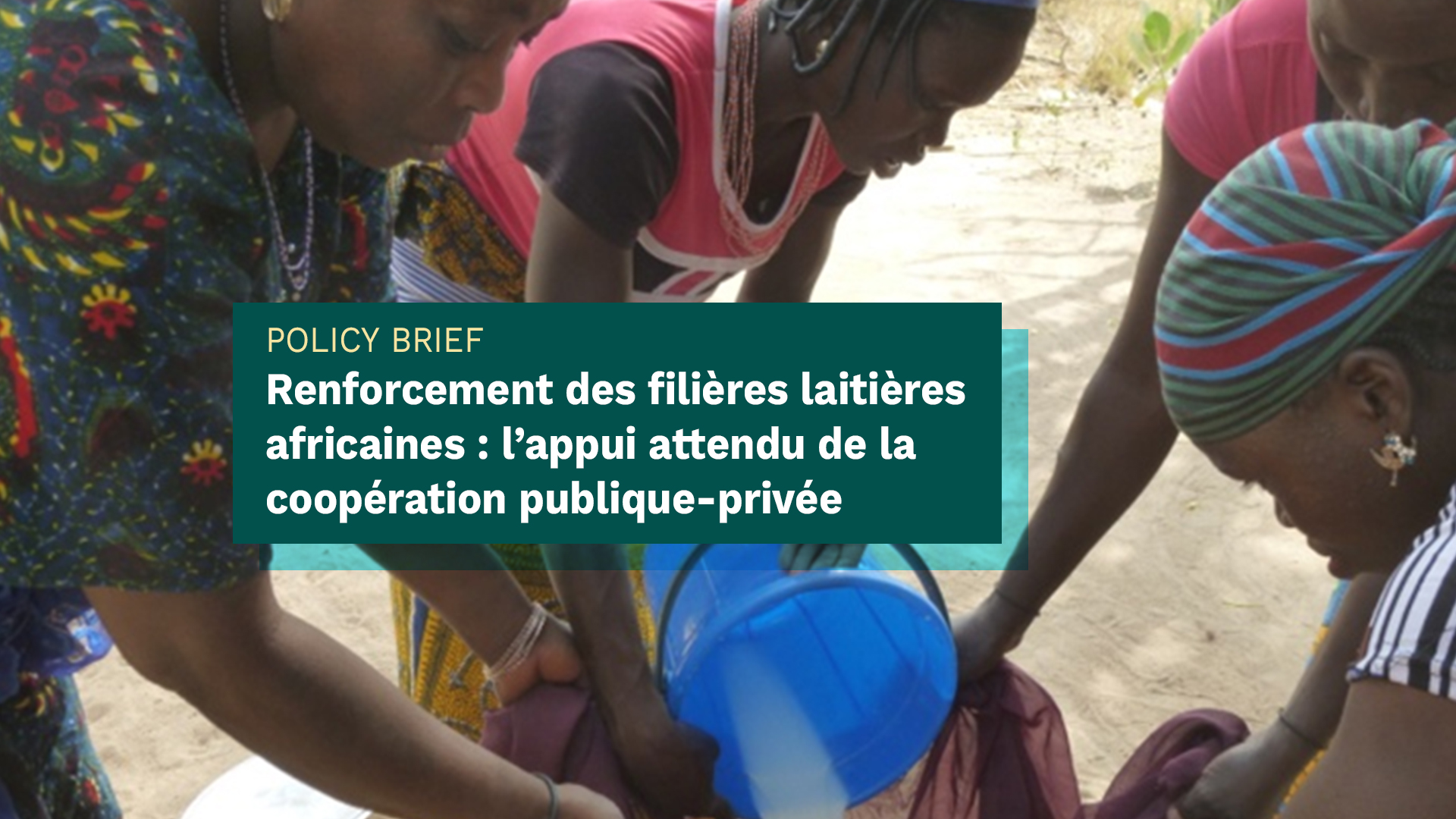
Strengthening African dairy sectors: the expected support of public-private cooperation
Montrouge, February 26, 2025 – The FARM Foundation and French Farmers and International Development (Afdi) organised a conference on the challenges of African dairy sectors on February 25 in Paris at the International Agricultural Show, with the support of researchers from CIRAD and the National Interprofessional Centre for the Dairy Economy (CNIEL), which hosted the event at its stand.
Speakers
– Matthieu BRUN, Scientific Director of the Foundation for Agriculture and Rural Development in the World (FARM)
– Christian CORNIAUX, researcher at the Centre for International Cooperation in Agricultural Research for Development (CIRAD)
– Alain HERBINET, Secretary General of French Farmers and International Development (Afdi)
– Stéphane JOANDEL, Secretary General of the National Federation of Milk Producers (FNPL)
This conference provided an opportunity to present recommendations to support local milk production in Africa and strengthen agricultural and trade policies by promoting strategic investments in dairy sectors by French and European players.
The challenge of sustainable development of dairy sectors in Africa in a few figures
In 2024, milk production in Africa was estimated at several billion dollars while the African dairy market is expected to continue growing to more than 8% by 2030, supported in particular by increasing demographics and urbanization.
In sub-Saharan Africa, more than 801,300 of dairy production comes from family producers, highlighting the importance of small farms and pastoralism.
However, the potential for local production is underutilized., only 20 % of the dairies located in West Africa source their milk locally.
In Morocco, where milk supply is a political priority, milk production fell by 20% between 2020 and 2022 due to droughts and inflation in raw material prices.
The development of the African dairy sector represents a major opportunity to improve farmers' livelihoods while meeting growing demand. Efforts to structure supply chains and promote sustainable practices will be essential to maximizing its potential.
In a context where demand for African dairy products is expected to double by 2050, The challenges related to the development and structuring of local supply chains appear to be major issues. The speakers reiterated that, faced with logistical constraints, competition from imports, and growing consumer demands, the question of cooperation between African and European stakeholders is critical to ensuring the sustainable development of the dairy sector. The speakers emphasized several points:
Christian Corniaux (CIRAD): «The population in West Africa has tripled, while production has only doubled in the last 60 years. The gap between local production and consumption is widening and is being filled by imports of milk powders reconstituted with vegetable oils. Consumers are not sufficiently informed about the origin of the milk and dairy products they consume. The «My Milk is Local» awareness campaign has demonstrated the importance of raising awareness on a large scale.».
Stéphane Joandel (FNPL): «The importation of milk powders must be handled with care; they should not be banned, but rather better regulated, considered as an adjustment variable while developing local supply chains. (…) Milk production and therefore livestock farming are very important for rural areas, for producing organic matter and fertilizing crops. Livestock farming is part of the solution for sustainable agriculture.».
Alain Herbinet (Afdi): «It is crucial to promote equitable and sustainable development of the sectors, in particular to recognize the essential work done by women, who are often responsible for the production of dairy products. They lack access to financing and are not recognized. Furthermore, investment in rural areas is essential, especially in infrastructure, to enable access to markets for local dairy products.».
Philippe Levillain (Agrial): «Partnerships with producer organizations in West Africa help strengthen local capacities. This type of initiative is based on technical training and the sharing of expertise, allowing farmers to develop their skills while optimizing the management of their resources.».
Matthew Brun (FARM): «The issue of milk transport, storage, and processing infrastructure is key, particularly the cold chain and access to electricity for producers in West Africa. We call on French and European companies to support dairy production in Africa and believe that cooperation between Africa and Europe/France can be based on three pillars: co-investment supported by public-private partnerships, a balanced trade relationship, particularly with North Africa for open strategic autonomy, and finally, technical cooperation on animal health and addressing the effects of climate change. We can work together in France, between the public and private sectors, to support our partners.».
The FARM Foundation
For 20 years, The Foundation for Agriculture and Rurality in the World (FARM), recognized as a public utility, works to promote sustainable agriculture in the world and in particular in the countries of the South.
Through its studies, partnerships and awareness campaigns, FARM informs public and private stakeholders about the paths to take for balanced agricultural development that addresses economic, social and environmental issues.
Press contacts
Marie-Laure Hustache: 06 69 25 04 42 – lagencedemarielaure@gmail.com
Vincent Manesse: 06 87 76 76 74 – vince.manesse@gmail.com
Louise Vignaud: louise.vignaud@afdi-opa.org