1.5 billion consumers, 20% of the world's cattle herd and 5% of global milk: the African paradox
Launch of a Barometer to inform public policies and guide international investments towards the continent's autonomy
Montrouge, October 14, 2025 FARM (Foundation for Agriculture and Rural Development in the World), PAFO (Pan-African Farmers' Organization), and Afdi (French Farmers and International Development) announced at the Livestock Summit the launch of the first Barometer of the African dairy sector. The result of a partnership between French and African organizations, this innovative tool offers a well-documented analysis of the dynamics of production, consumption, trade, investment, and public policy in African countries. The analysis reveals significant, yet still largely untapped, potential, as well as stark disparities between countries. The Barometer will help local policymakers and professional organizations influence agricultural policies through robust data. The ambition is also to guide international cooperation and investment towards fair and sustainable trade, conducive to strengthening the continent's food self-sufficiency. Africa has a considerable trade deficit in the dairy sector, amounting to $6.4 billion in 2023.
Globally, Africa is home to 20% of the world's cattle herd, but produces only 5% of the milk.
Faced with the climatic, geopolitical, and economic upheavals that are weakening global food systems, dairy sovereignty in Africa is emerging as a major strategic issue. Milk, a product essential to nutrition and the vitality of rural areas, highlights various challenges: dependence on imports, the potential for local production, and aspirations for food self-sufficiency.
In 2022, the average milk availability on the African continent was 45.6 kg per capita per year. This level is lower than the WHO recommendations for individual consumption (70 to 90 kg/year) and far below the global average (118 kg/capita/year). However, significant disparities exist across the continent. East Africa stands out for its high level of self-sufficiency, with a regional self-sufficiency rate of 99.5%, while Central Africa is heavily dependent on imports, with a regional self-sufficiency rate of only 18%. A telling statistic: Africa is home to 20% of the world's cattle herd and produces 51% of global milk. The findings are clear: despite growing demand fueled by the continent's population growth, local milk production is struggling to keep pace, hampered by inadequate infrastructure, low added value for local products, and competition from imported milk powder. Imports of milk powders reconstituted with vegetable matter have increased by 41% since 2013. Two-thirds of these products are destined for West Africa where they are generally sold 50% cheaper than local milk.
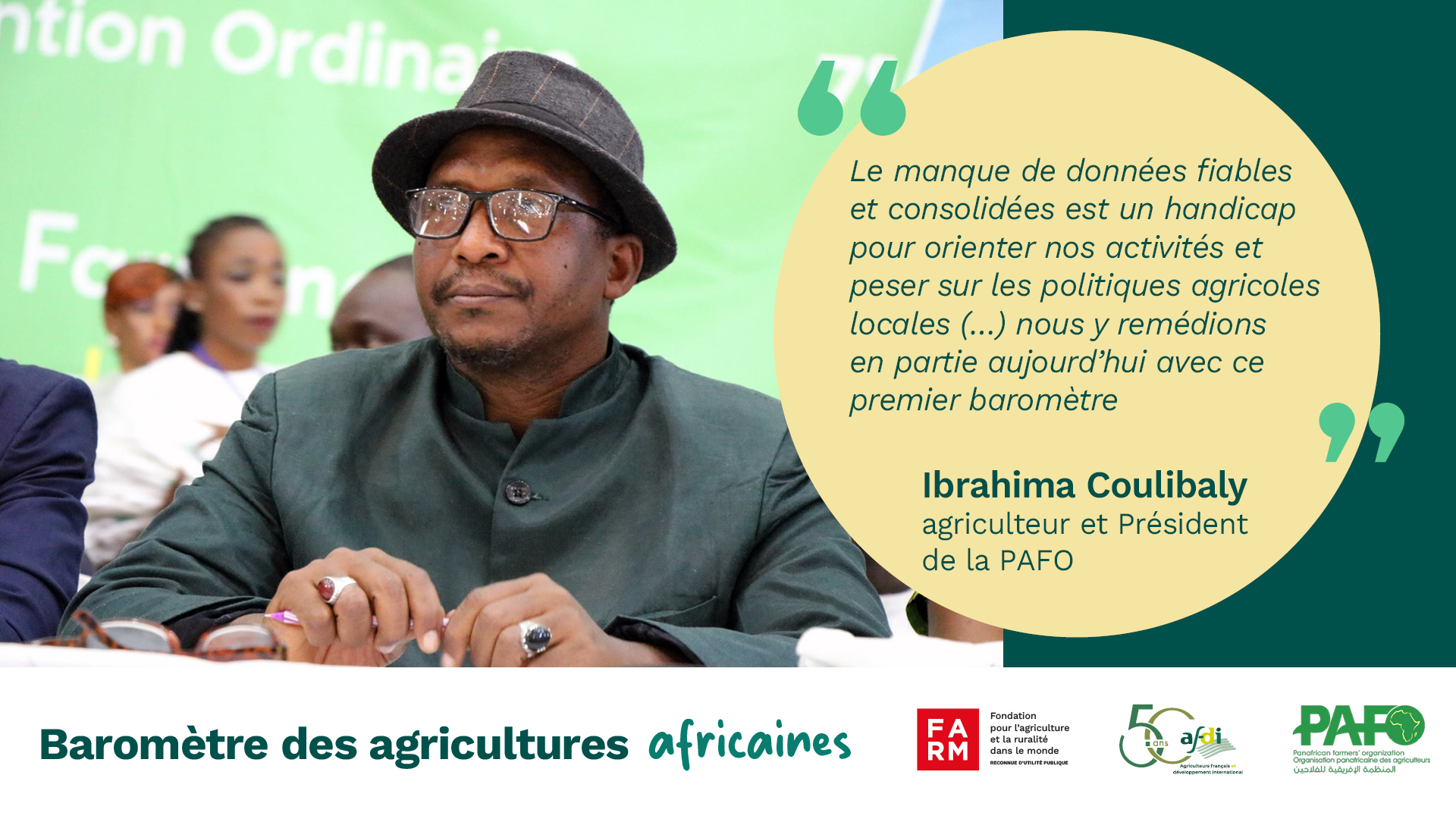
The development of dairy value chains faces major infrastructural constraints. The poor state of road networks and the lack of access to electricity for over 600 million Africans particularly hinder the establishment of efficient cold chains, essential for adding value to milk. Another significant obstacle is the absence of decision-support tools. For Ibrahima Coulibaly, farmer and President of PAFO, "the lack of reliable and consolidated data is a handicap for guiding our activities and influencing local agricultural policies; we are partially addressing this today with this first barometer." With appropriate mechanisms, family farmers could be the cornerstones of a sector capable of sustainably feeding populations, creating jobs, and strengthening rural economies.
To favorably direct international investments and include local actors in the transformation
of the sector
For all three organizations, dairy sovereignty cannot be achieved without coherent public action, responsible investment, and international cooperation based on a co-construction approach with local stakeholders, supporting inclusive and sustainable economic models. Kenya, with its 2023-2032 roadmap, is leading the way by adopting a facilitating state role to double production, focusing on infrastructure and public-private partnerships. West Africa and ECOWAS have also launched an ambitious program, the Dairy Offensive.
At a time when corporate social responsibility plays a significant role in the governance and reputation of Western economic actors, the nature of their investments in Africa warrants closer examination. The industrial development of the dairy sector is therefore a strategic issue that relies in part on investments from multinational corporations. In this area, an analysis of foreign investment reveals a European predominance: Danone, Lactalis, Nestlé, FrieslandCampina, and Arla Foods clearly dominate operations on the continent. The barometer also examines dairy equipment imports by different countries, revealing significant disparities. The top five importing countries (Angola, Kenya, Egypt, and South Africa) alone account for 57% of continental African equipment imports. However, these acquisitions have not translated into a significant increase in local milk processing across the continent. In 2022, only 1.6% of African milk production was processed into derivative products, such as powder, cheese and yogurt.
Finally, while cooperatives and producer organizations must be fully involved in the transformation and structuring of value chains, the modernization of the dairy sector also raises crucial social equity issues. Women, who represent 50% of the sub-Saharan agricultural workforce, occupy a central position in traditional milk processing. Their inclusion in the processes of modernizing supply chains is essential.
The challenge of sustainable development of dairy sectors in Africa in a few figures
In 2024, milk production in Africa was estimated at several billion dollars while the African dairy market is expected to continue growing to more than 8% by 2030, supported in particular by increasing demographics and urbanization.
In sub-Saharan Africa, more than 801,300 of dairy production comes from family producers, highlighting the importance of small farms and pastoralism.
However, the potential for local production is underutilized., only 20 % of the dairies located in West Africa source their milk locally.
In Morocco, where milk supply is a political priority, milk production fell by 20% between 2020 and 2022 due to droughts and inflation in raw material prices.
The development of the African dairy sector represents a major opportunity to improve farmers' livelihoods while meeting growing demand. Efforts to structure supply chains and promote sustainable practices will be essential to maximizing its potential.
Some figures and data from the Barometer
Climate warming could reach nearly 4°C in Africa by the end of the 21st century. The impact on livestock performance is resulting in decreased production: the 2020-2023 drought in Kenya caused the death of 2.6 million livestock. Morocco's milk production fell by 20% between 2020 and 2022, largely due to the same climatic events.
➔ According to UN forecasts, Africa will have nearly 2.5 billion inhabitants by 2050, or 25 % of the world's population.
➔ Overall, Africa had a continental milk self-sufficiency rate of 74.9 % in 2022. This rate has been declining since 2012 (when it was 82 %). The milk self-sufficiency rate in the European Union was 115 % in 2022.
➔ Eight countries (Egypt, Kenya, Ethiopia, Sudan, Tanzania, South Africa, South Sudan and Algeria) account for 67 % of African milk production, illustrating a strong geographical concentration.
➔ In 2023, African countries imported $7.5 billion worth of dairy products (New Zealand is the leading supplier of dairy products to Africa / $1 billion worth of products exported).
➔ Whole and skimmed milk powders are the largest import category, reaching $3.4 billion in 2023, representing moderate growth (+4.5 million TEUs between 2013 and 2023). Imports of powders fortified with vegetable fats (VF) have increased by 41.2 million TEUs since 2013.
➔ In Uganda, a self-sufficient country (108 million TEUs), the industry has experienced remarkable growth over the last 10 years (+5 to 7 million TEUs per year). The dairy sector has been the subject of government planning since 2015, which emphasizes agro-industrialization. Having become an exporter, particularly of milk powder, Uganda is primarily targeting African markets and made its first intra-African exports to Algeria in 2025, worth $500 million.
➔ The study of dairy equipment imports reveals significant geographical disparities. North Africa imported 38 million metric tons (%) of the continental total between 2013 and 2023, followed by East Africa (29 %). Central Africa accounted for only 16 % of these imports, while West Africa (9 %) and Southern Africa (7 %) remained relatively small.
English version
About
Afdi
French Farmers and International Development (Afdi) is an international solidarity association created by French agricultural professional organizations. It supports family farmers to earn a decent living and ensure the sustainability of their farms. Present in 19 countries in Africa, Asia, and the Eastern Caribbean, Afdi supports partner farmers' organizations and raises awareness among French agricultural professionals, particularly young people, about international solidarity and civic responsibility.
FARM Foundation
For 20 years, the Foundation for Agriculture and Rural Development in the World (FARM), a recognized public-interest organization, has been working to promote sustainable agriculture worldwide, particularly in developing countries. Through its studies, partnerships, and awareness campaigns, FARM informs public and private stakeholders about the paths to take for balanced agricultural development that addresses economic, social, and environmental challenges.
PAFO
The Pan-African Farmers' Organization (PAFO) is the unified voice of over 80 million African farmers, supported by five major regional networks and 80 national organizations in 50 countries across the continent. Founded in 2010 under the auspices of the African Union, PAFO represents the interests of farmers' organizations continent-wide, advocating for inclusive, sustainable, and producer-centered agriculture. It brings together cooperatives, federations, and associations to strengthen the role of farmers in African agricultural policies.
Press contacts
Marie-Laure Hustache: 06 69 25 04 42 – lagencedemarielaure@gmail.com
Vincent Manesse: 06 87 76 76 74 – vince.manesse@gmail.com
Louise Vignaud: louise.vignaud@afdi-opa.org