Guiana Shield: Transforming considerable agricultural potential into shared food sovereignty
Macouria, October 16, 2026 — The white paper "Guiana agriculture facing the challenge of food sovereignty"« has just been published by the FARM Foundation. It is being presented today for the first time by Juliette LECLAIRE, Director General of the Foundation and the project partners, at the SAREGA trade fair in Macouria (French Guiana).
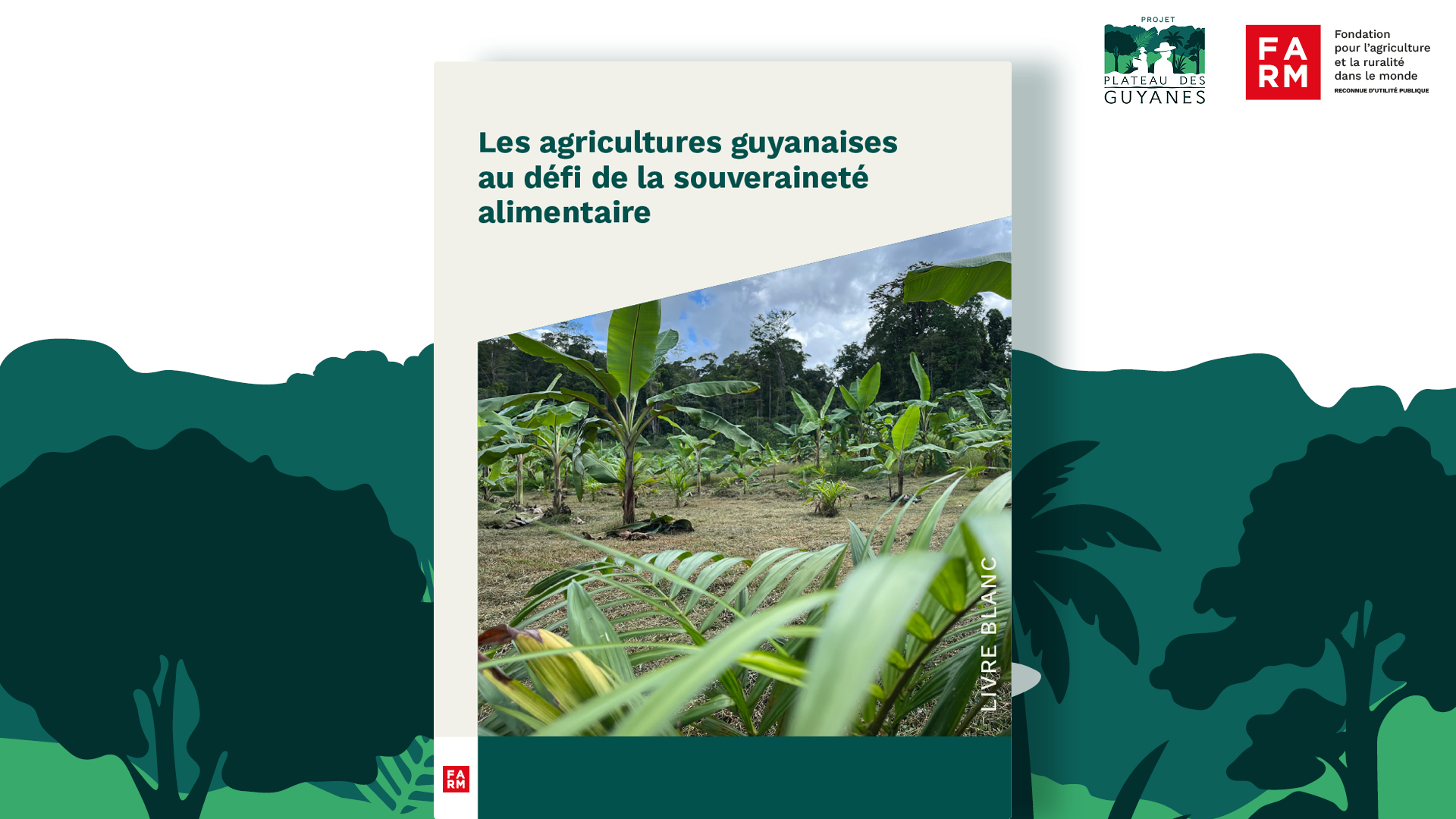
With the support of the members of the steering committee of the Plateau des Guyanes project: Crédit Agricole Martinique Guyane, Safer Guyane and the Chamber of Agriculture Guyane.
The Guiana Shield (French Guiana, Suriname, and the Brazilian state of Amapá) shares a common Amazonian space, rich in water, biodiversity, agricultural expertise, and diverse agricultural production. The white paper shows that this potential has not yet translated into structured production systems and sufficient cooperation to feed the population.
The result of a project carried out in partnership with Safer Guyane, Crédit Agricole Martinique Guyane, the Chamber of Agriculture of Guyana and listening to stakeholders on the ground, this white paper exclusively provides an overview of the strengths, weaknesses and above all the strong development opportunities for the territory.
According to Juliette LECLAIRE, "« This work constitutes a starting point. The ambition is to initiate a collective dynamic around priorities shared by the entire plateau, as regional cooperation appears to be a powerful lever of sovereignty. ".
The meeting is scheduled for January 2027 to develop a jointly constructed action plan to meet the challenge: to feed 1.8 million inhabitants (300,000 in French Guiana) better and sustainably, compared to just over 1 million in 2020. Rapid population growth further increases the pressure on food.
Putting agriculture back at the heart of development
French Guiana, Amapá, and Suriname rely on external supplies for many essential commodities: cereals, dairy products, meat, processed foods, and certain inputs necessary for production. This situation is not solely due to a production deficit. It also stems from the fragility of production and agri-food systems, land tensions, a lack of infrastructure, and limited regional cooperation.
Some economic trajectories, marked by external rents (oil in Suriname, administrative and spatial in French Guiana) have also diverted part of the workforce and investments away from the local productive apparatus.
In a context of household vulnerability to food prices and exposure to climatic and geopolitical hazards, Guyanese agriculture is a central element in the development of the territories.
More structured sectors to unlock strong potential
The territory is not starting from scratch: slash-and-burn agriculture, Creole gardens, family farms, and livestock already contribute to feeding the population. However, these agricultural practices remain largely invisible due to the informal nature of trade. Practices adapted to the Amazonian environment—fertility and water management, crop diversity, agroforestry, and intercropping—constitute valuable resources. Agro-processing is a key lever for adding value to local products.
Animal production is insufficient. In French Guiana, cattle farming, the most structured sector in the territory, covers only one-fifth of local consumption.
The challenge is not simply to increase volumes. Local supply must become more consistent, accessible, and more valuable in the market. For Juliette Leclaire, « This is a realistic objective provided it is based on strengthened producer organizations and stabilized relationships between producers, processors, and distributors. ".
In French Guiana, land ownership: the first obstacle
The territory has approximately 8 million hectares of forest cover, with 97 million hectares (1.3 million TEUs) covered by forest, while the utilized agricultural area reached approximately 36,000 hectares in 2020, representing less than 0.5 million TEUs of the territory. Nearly a decade after the 2017 Guiana Agreement, the transfer of the 250,000 hectares intended for local communities remains incomplete.
Safer Guyane, established only in 2021, has a pre-emption right that is still largely ineffective and insufficient resources. Added to this is a generational renewal crisis: the average age of farm managers is increasing, and 14,130 farms are facing impending retirement without an identified successor.
Public support policies can sometimes exacerbate the very obstacles they are intended to resolve. The POSEI, the main European program dedicated to overseas territories, allocated only about 3,130,000 euros to French Guiana out of a total budget of 321 million euros.
Regional cooperation, a lever for sovereignty and sustainable development
French Guiana's proximity to Suriname and Brazil results in daily mobility and exchanges that clash with frameworks designed far removed from local realities. This fosters informal flows, particularly due to differences in prices, production costs, and standards.
According to the CEO of the FARM Foundation, "« The objective should be to gradually build formal, reciprocal exchanges within a coherent framework, to complement local capacities and not replace them. ".
Cooperation is also relevant for jointly addressing common issues: plant health monitoring, animal health, adaptation to climate change, agronomic research, varietal selection, training, sharing of technical references, market information and innovation.
For the FARM Foundation and its partners, a new phase of concrete mobilization is beginning: securing and restoring already cultivated land, stabilizing agricultural training and advisory services, redirecting public support towards food supply chains, and building targeted partnerships with Suriname and Brazil. It is by working collectively in this direction that food sovereignty for the Guiana Shield can become a gradual and shared path forward.
The FARM Foundation
Think and do tank French standard, For 20 years, the Foundation for Agriculture and Rural Development in the World (FARM), a recognized public-interest organization, has been working to promote sustainable agriculture worldwide, particularly in developing countries. Through its studies, partnerships, and awareness campaigns, FARM informs public and private stakeholders about the paths to take for balanced agricultural development that addresses economic, social, and environmental challenges.
About the partners

Safer Guyana is the regional land operator for rural and peri-urban areas, responsible for regulating the land market, developing agriculture, and supporting public policies. Its primary objective is to facilitate the effective establishment of farmers on plots of land suited to their projects.
The Regional Bank of Crédit Agricole Martinique-Guyane, cooperative and mutual bank, has joined the partnership to support the sustainable development of sectors and the promotion of agricultural professions, as climate change intensifies the risks faced by farmers.
The Chamber of Agriculture of French Guiana. As a field actor, it provides technical support to farmers, represents their concerns and facilitates the implementation of actions in the territory.
Press contacts
Marie-Laure Hustache: 06 69 25 04 42 – lagencedemarielaure@gmail.com
Vincent Manesse: 06 87 76 76 74 – vince.manesse@gmail.com