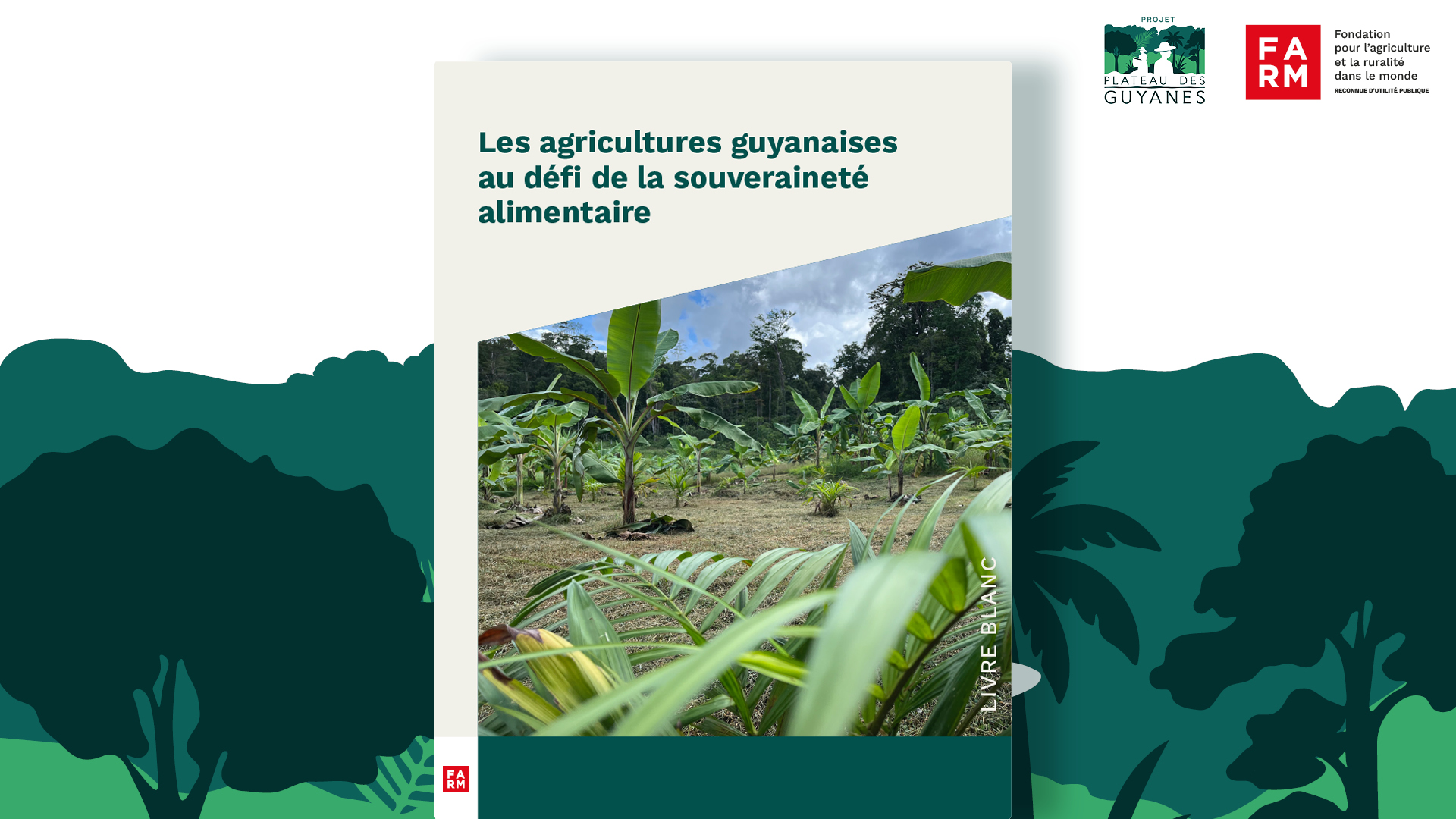
White paper: Guyanese agriculture facing the challenge of food sovereignty
In northeastern South America, French Guiana, Suriname, and the Brazilian state of Amapá share the same Amazonian region, rich in water, biodiversity, agricultural production, and know-how. Yet, these territories remain dependent on external supplies for a significant portion of their food.
Published in October 2026 by the FARM Foundation, «"Guyanese agriculture faces the challenge of food sovereignty"» This is the first white paper of the Plateau des Guianas project.
Launched in Kourou in December 2025, the project aims to to build food sovereignty adapted to the realities of the territories, by reconciling agricultural development and the preservation of ecosystems.
Based on FARM's assessment and discussions with local stakeholders, this white paper offers a common ground for understanding, dialogue, and prioritization. It highlights the main obstacles and interdependencies needed to move from assessment to action and foster new collaborations, projects, and investments.
With the support of the members of the steering committee of the Plateau des Guyanes project: Crédit Agricole Martinique Guyane, Safer Guyane and the Chamber of Agriculture Guyane.
Executive Summary
Suriname, French Guiana and the Brazilian state of Amapá They share an Amazonian space rich in water, biodiversity and ancient agricultural know-how. This area now encompasses approximately 1.8 million inhabitants, compared to just over one million at the beginning of the 2000s, a rapid population growth that increases the pressure on food each year.
Despite this potential, the three territories remain heavily dependent on imports for a significant portion of their food.. This dependence is not simply a matter of agricultural backwardness: it is part of economic trajectories marked by external rents (oil in Suriname, administrative and spatial in French Guiana) which have diverted part of the workforce and investments from the local productive apparatus, a dynamic which has certain characteristics close to what economics calls the "Dutch syndrome".
Food sovereignty does not mean self-sufficiency.
It refers to the capacity of populations and institutions to decide what is produced, where and how, to reduce the riskiest dependencies, and to build with neighboring territories complementarities that are chosen rather than imposed.
The Guiana Shield is not starting from scratch Slash-and-burn agriculture, Creole gardens, family farms, and livestock farming already contribute to daily food supplies, but remain largely invisible in statistics. The profiles vary considerably: export rice in Suriname, diversified but insufficient production in French Guiana, and subsistence farming and expanding soybean production in Amapá.
In all three territories, animal production represents a significant point of vulnerability: In French Guiana, cattle farming, the most structured sector in the territory, covers only one-fifth of local consumption. The cassava "witch's broom" disease, which appeared around 2022, illustrates the vulnerability of these systems: yield losses of 30 to 100% depending on the location, doubling of the price of cassava semolina in some areas, emergency distributions in isolated indigenous villages.
In French Guiana, land ownership is the focal point of the blockages.
The territory has approximately 8 million hectares covered by 97,130 tons of forest., While the utilized agricultural area reached approximately 36,000 hectares in 2020, representing less than 0.5 million tons of the territory, nearly a decade after the 2017 Guiana Agreement, the implementation of the planned transfer of 250,000 hectares to local communities remains largely incomplete.
Safer Guyane, established only in 2021, has a pre-emption right that is still largely ineffective and resources deemed insufficient. Added to this is a generational renewal crisis: the average age of farm managers is increasing, and 14,130 farms are facing impending retirement without an identified successor.
Public support policies can sometimes exacerbate the very obstacles they are intended to resolve.. The POSEI, the main European program dedicated to overseas territories, allocated only about 3,130,000 of a total budget of €321 million to French Guiana during the reference years considered. The overseas tax, intended to protect local production, increases the cost of legal trade and paradoxically makes informal imports more competitive.
At the regional level, a recent Senate report describes French Guiana as a "continental territory on the margins of its own environment".
The figures confirm it. : in 2024, French Guiana imports 4.7 million euros from Suriname and 7 million from Brazil, compared to 139 million from Martinique and 84 million from Guadeloupe.
Informal trade, however, covers a significant portion of consumption needs., In a context where the administration demonstrates pragmatic tolerance, aware that it could not stop the problem without jeopardizing the food security of the poorest households, the infrastructure reflects this isolation: the port of Dégrad-des-Cannes remains too small for modern container ships and sees its containers leave empty, while the bridge over the Oyapock remains underutilized for freight due to cumbersome customs procedures.
This white paper does not impose a predetermined path. : it offers a common diagnostic basis to bring together scattered initiatives.
A new phase of concrete mobilization is beginning. Securing and restoring existing cultivated land, stabilizing agricultural training and advisory services, redirecting public support towards food production sectors, and building targeted partnerships with Suriname and Brazil focused on plant and animal health, research, and training are essential. Only then can food sovereignty in the Guiana Shield become a gradual and shared path.

