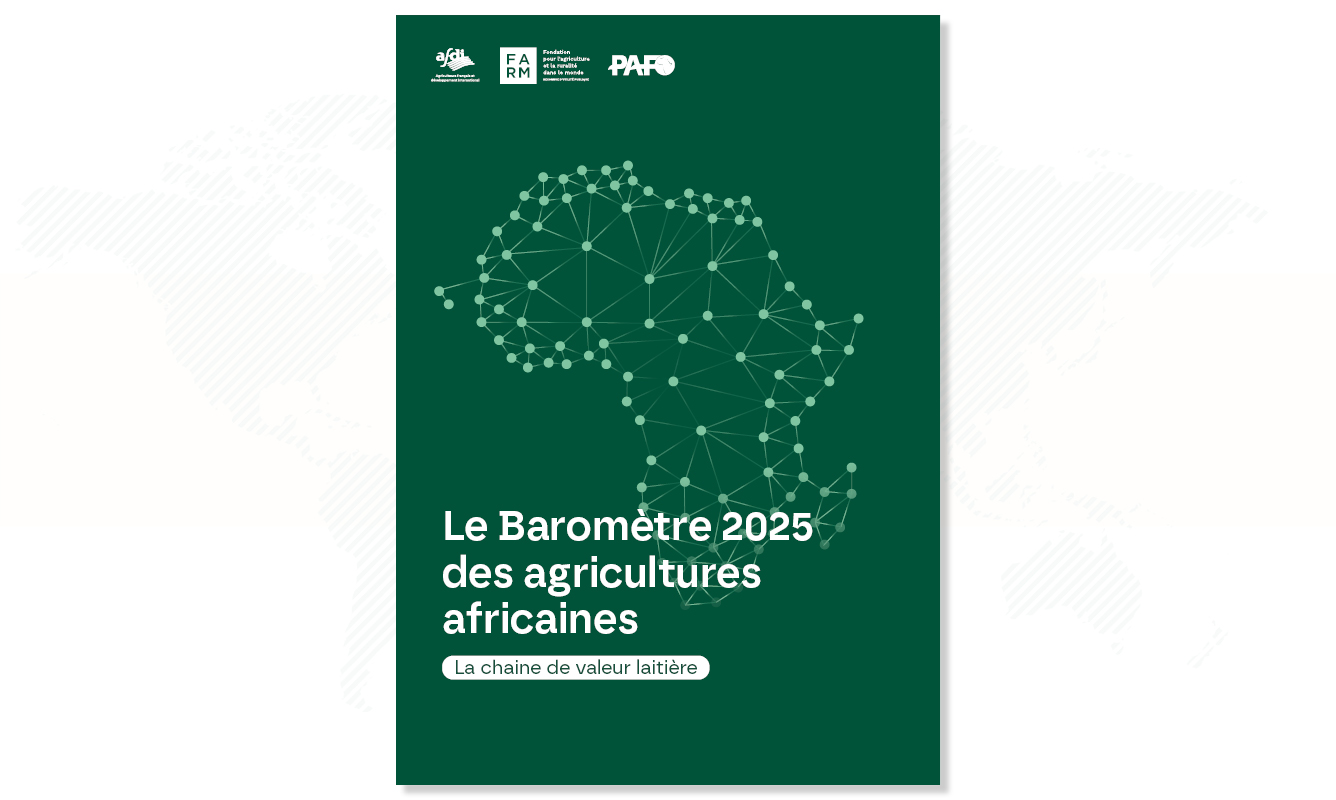
The FARM Foundation, in partnership with Afdi (French Farmers and International Development) and the Pan-African Farmers' Organization (PAFO), publishes the first Barometer of African agricultures dedicated to the dairy value chain.
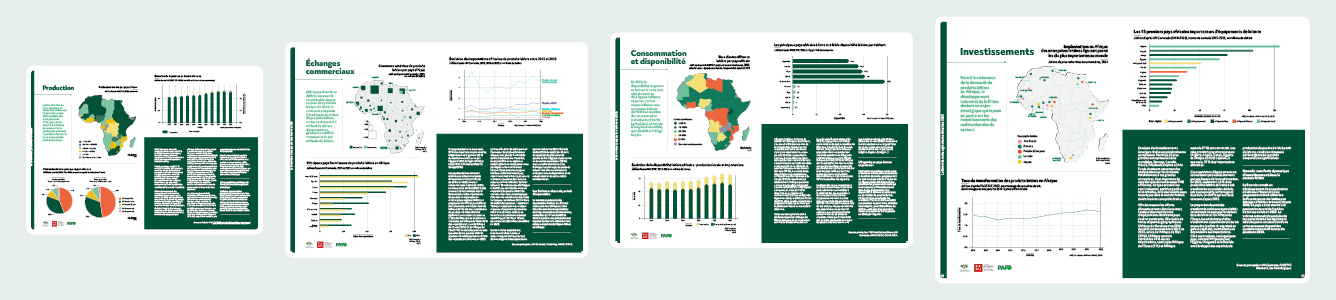
This strategic tool for analysis, dialogue and decision support offers a documented reading of the dynamics of production, consumption, trade, investment and public policies on the continent.
🧭 Why was this Barometer created?
Health, geopolitical and climate crises Recent events have highlighted the vulnerability of global food systems and revived debates around food sovereignty.
Faced with this observation, Representative organizations of African producers have expressed a critical need:
access to reliable, up-to-date and comparable data,
to guide their strategy and influence local agricultural policies.
Designed with and for them., The African Agriculture Barometer aims to cover several sectors across the continent. It addresses the Sustainable Development Goals (SDGs 1, 2, 8, 9, 12 and 13), in line with the African Union's Agenda 2063.
The starting point of this series, The first edition is dedicated to the dairy value chain in Africa.
To extend this work, the partners are preparing an online platform dedicated to the Barometer..
🎯 In concrete terms, what is the Barometer used for?
It relies on robust data and cross-analyses to inform the choices of three audiences:
Peasant organizations They draw on solid evidence and comparable data to support their arguments.
Public institutions and decision-makers They find a factual basis for calibrating public policies (subsidies, regulation, investments).
Economic actors rely on its mapping of dependencies and opportunities to move towards sustainable co-investments, built with local actors.
Technical and financial partners, researchers and media They also contain reference data on African agriculture.
Milk, a product essential to nutrition and the vitality of regions, highlights three issues:
dependence on imports;
local production potential;
and aspirations for agri-food self-sufficiency.
This first edition also aims to be a call to action : to make milk a lever of sovereignty, social justice and prosperity for the African continent.
Analysis of the dairy sector reveals considerable potential, which is still insufficiently exploited, as well as significant continental disparities:
On a global scale, Africa is home to 20 % of the world's cattle herd, but produces only 5 % of the world's milk. Although production has increased by 17 million tons over ten years, average availability (45.6 kg/capita/year) remains below WHO recommendations (70 to 90 kg/year). The continent's overall self-sufficiency has declined slightly, from 82 million tons in 2012 to 80 million tons in 2022.
On a global scale, Africa is home to 20 % of the world's cattle herd, but produces only 5 % of the world's milk. Although production has increased by 17 million tons over ten years, average availability (45.6 kg/capita/year) remains below WHO recommendations (70 to 90 kg/year). The continent's overall self-sufficiency has declined slightly, from 82 million tons in 2012 to 80 million tons in 2022.
The continent has a dairy trade deficit of $6.4 billion in 2023. Imports of vegetable fat-reconstituted (VFR) powders have increased by 41.2 million tons since 2013. Two-thirds of these low-end products are destined for West Africa, where they are generally sold 50 % cheaper than local milk, directly competing with family producers.
Overcoming obstacles (access to land, financing, climate change) is essential to ensuring the future of agriculture and strengthening the autonomy of women, who occupy a central position in traditional transformation. Without the capacity for collective representation and the structuring of farmers' organizations, no value chain strategy can be effective.
Dairy sovereignty requires coherent and sustainable public policies. Encouraging regional trends exist: East Africa boasts a self-sufficiency rate of 99.5%. Countries like Uganda (which has become an exporter through planning focused on agro-industrialization) and Kenya (Africa's second-largest producer, protecting its domestic market) are paving the way for successful public-private partnerships.
📊 Key figures to remember on dairy sectors in Africa
7.5 billion $: total value of African dairy product imports in 2023.
67 % : the share of African milk production concentrated in only 8 countries (Egypt, Kenya, Ethiopia, Sudan, Tanzania, South Africa, South Sudan, Algeria).
57 % : the share of dairy equipment imports captured by the top 5 purchasing countries (Algeria, Angola, Kenya, Egypt, South Africa).
2.6 million: the number of livestock animals that died in Kenya during the 2020-2023 drought, illustrating vulnerability to climate change.
🎬 Testimonials and shared perspectives
«"The lack of reliable and consolidated data is a handicap for guiding our activities and influencing local agricultural policies (...) we are partially addressing this today with this first barometer."»
— Ibrahima Coulibaly, farmer and former President of PAFO.
«Young people face many difficulties in getting involved in agriculture: access to land, factors of production, and financing. These obstacles hinder the next generation of farmers. Overcoming them is essential to building a self-sufficient dairy sector and strengthening women's autonomy.»
— Modest Dayato, farmer in Benin.
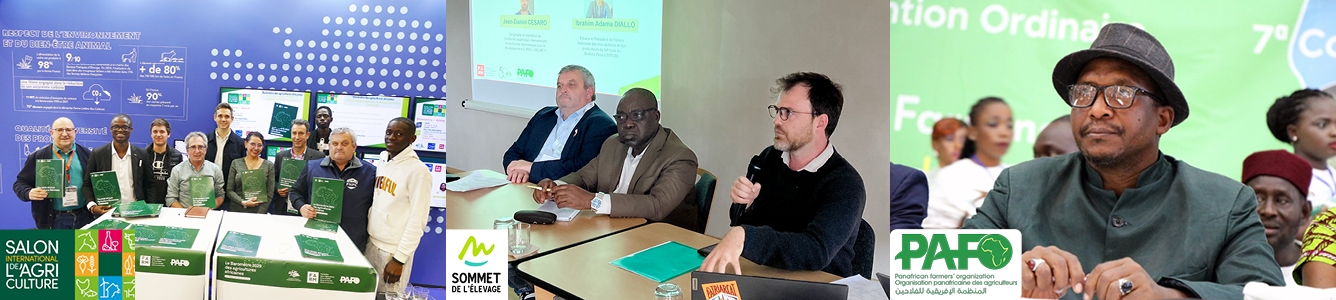
🎤 Invite the Barometer's partners to participate in your events!
The Barometer's partners travel to present and discuss its findings at your conferences, roundtables, webinars, or institutional meetings., in French as well as in English.
Some topics for intervention:
(self-sufficiency, imports, growing demand, local processing)
(one of the central findings of the Barometer)
(Population growth, urbanization and the future of dairy production)
(Investment, value addition and dairy sector development)
Also share the report, available in French and English., within your networks to foster discussions on the future of agriculture and food in Africa.